When a geophysical or mapping program fails, the root cause is rarely the sensor alone. More often, the issue sits inside the survey calibration and validation workflow - where instrument behavior, flight execution, environmental conditions, and processing assumptions either become controlled variables or compound into uncertainty. For enterprise buyers and technical project teams, that distinction matters because a dataset is only as defensible as the process used to verify it.
In drone-based geospatial operations, calibration and validation are not administrative steps added after acquisition. They are embedded controls that determine whether magnetic gradients are interpretable, whether LiDAR elevations meet tolerance, whether photogrammetric models close properly, and whether a client can rely on outputs for engineering, exploration, groundwater targeting, or regulatory reporting. The workflow has to be repeatable, documented, and auditable from mobilization through final deliverables.
What the survey calibration and validation workflow is designed to control
A disciplined workflow exists to reduce measurement bias, quantify residual error, and confirm that the final product is fit for its intended use. That sounds straightforward, but in practice each sensor class introduces different failure modes. Magnetometers drift. GNSS quality degrades under poor satellite geometry or multipath. IMUs accumulate error through vibration and thermal effects. LiDAR boresight misalignment can distort surfaces. Photogrammetry can produce visually convincing models that still fail absolute accuracy checks.
That is why calibration and validation must be treated as separate but linked controls. Calibration aligns instruments and processing parameters to known references or expected system behavior. Validation then tests the resulting outputs against independent checks. If those two steps are blurred together, teams can end up confirming their own assumptions rather than proving data quality.
For industrial clients, the commercial impact is direct. Weak control at this stage creates reflight risk, interpretation ambiguity, schedule slippage, and procurement disputes over acceptance criteria. Strong control reduces those exposures and gives project owners a documented basis for technical decisions.
Building the workflow before field deployment
A credible survey calibration and validation workflow starts well before the first flight line. The first requirement is a fit-for-purpose specification tied to the business objective. A groundwater reconnaissance program does not carry the same control thresholds as corridor engineering design, and a reconnaissance magnetic survey does not require the same validation density as a detailed infrastructure-grade terrain model. The workflow must be scaled to the decision it supports.
At planning stage, survey teams define sensor configuration, positional accuracy targets, line spacing, terrain constraints, expected sources of interference, and acceptance thresholds for both raw and processed data. This is also where control philosophy is established. For example, a LiDAR mission may require surveyed ground control and independent checkpoints, while an aeromagnetic program may prioritize heading tests, compensation checks, repeat lines, and base-station correlation.
Environmental context must be built into planning. Desert heat, dust loading, magnetic noise from nearby infrastructure, and variable surface reflectance all affect sensor performance. A workflow that performs well in benign conditions may not hold the same tolerances in remote, high-temperature industrial sites. Mature operators account for this early rather than explaining it later.
Field calibration: proving the platform is behaving as expected
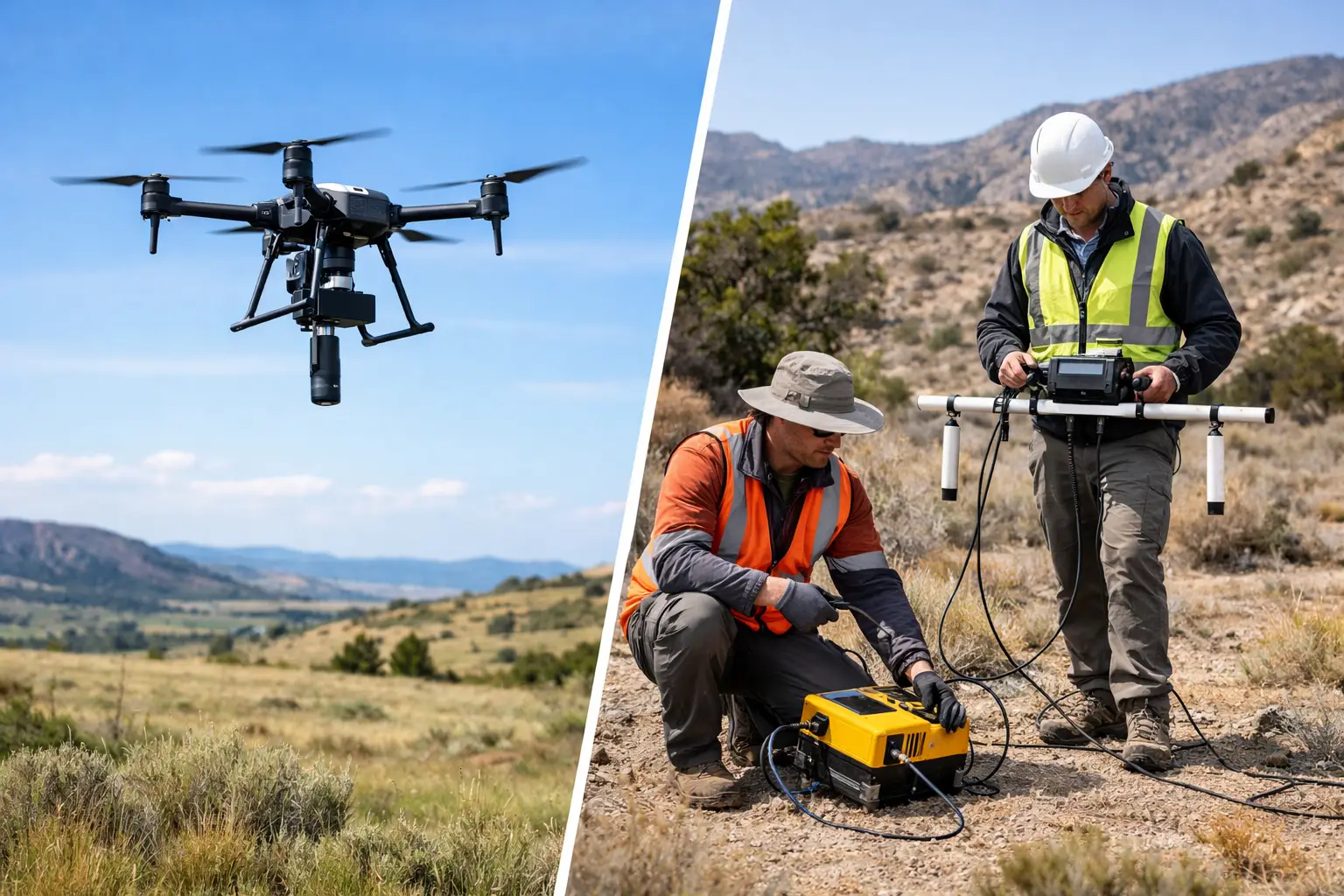
Field calibration verifies that the aircraft, sensor payload, positioning system, and timing architecture are operating as an integrated measurement system. This is especially important in multi-sensor deployments, where timestamp offsets or mounting geometry errors can degrade every downstream product.
For positional systems, calibration typically begins with GNSS initialization, base-station verification where applicable, time synchronization checks, and confirmation of antenna offsets. For inertial systems, teams review warm-up behavior, vibration signatures, and alignment stability. In LiDAR operations, boresight calibration is used to quantify roll, pitch, and yaw misalignment between the laser scanner and navigation system. In photogrammetry, lens characteristics, shutter behavior, image overlap, and camera orientation all require confirmation.
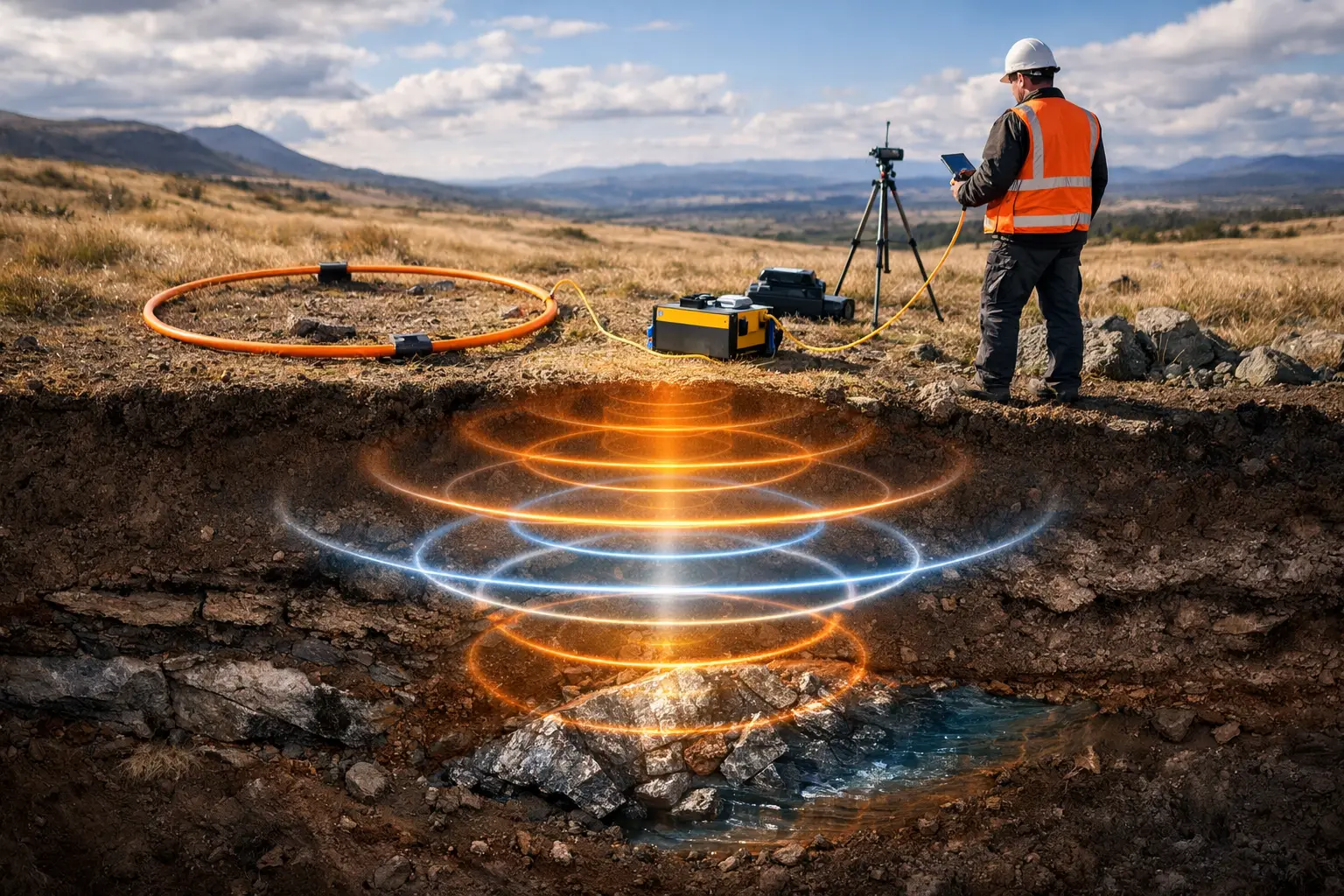
Geophysical payloads require their own controls. Magnetometers must be checked for platform noise, sensor heading effects, and diurnal correction compatibility. Electromagnetic systems require transmitter-receiver integrity checks, waveform verification, and sensitivity testing against expected conductivity contrasts. Radiometric instruments need energy calibration and background assessment. The point is not to perform calibration as a one-time checkbox, but to establish a measurable baseline before production lines begin.
This stage also reveals when operational trade-offs are necessary. A lower flight altitude may improve anomaly resolution but increase terrain-following complexity. A slower airspeed may improve data density while reducing daily coverage. Additional repeat lines improve validation strength but add cost and flight time. Decision-grade workflow design acknowledges those trade-offs openly.
In-flight quality control is part of validation, not an afterthought
The strongest survey teams validate continuously during acquisition. Waiting until post-processing to discover navigation drift, line mis-ties, poor overlap, or sensor dropout is an expensive way to run a program.
In-flight QA/QC typically monitors line adherence, altitude stability, sensor health, GNSS lock quality, IMU behavior, and environmental anomalies. For geophysical programs, operators review real-time noise levels, heading consistency, and repeatability across test lines. For mapping missions, they check overlap, exposure consistency, return density, and preliminary surface coherence.
Repeat lines and cross-lines are particularly important because they create independent internal checks. If line intersections show systematic mismatch, the issue may be calibration error, timing offset, processing bias, or unstable platform behavior. These discrepancies should trigger immediate investigation while the crew is still mobilized and the aircraft is still on site.
That is one of the clearest differences between commodity data capture and high-reliability survey execution. The latter treats field validation as a mechanism for preventing bad datasets, not documenting them.
Post-processing validation: turning measurements into defensible products
Processing does not fix poor acquisition, but it does determine whether a calibrated dataset becomes technically usable. This is where raw observations are corrected, aligned, filtered, fused, and tested against acceptance criteria.
For geospatial products, validation usually includes checkpoint residual analysis, surface comparison against known control, strip alignment review, and consistency testing across overlapping areas. For geophysical products, it includes tie-line leveling, noise analysis, diurnal correction assessment, heading correction review, and comparison with expected geological or infrastructure signatures where reference information exists.
Independent validation matters here. A model should not only fit the control used to build it. It should also perform against withheld checkpoints or external references. In practical terms, that means separating calibration inputs from validation datasets wherever possible. If the same observations are used to tune and confirm the product, confidence is overstated.
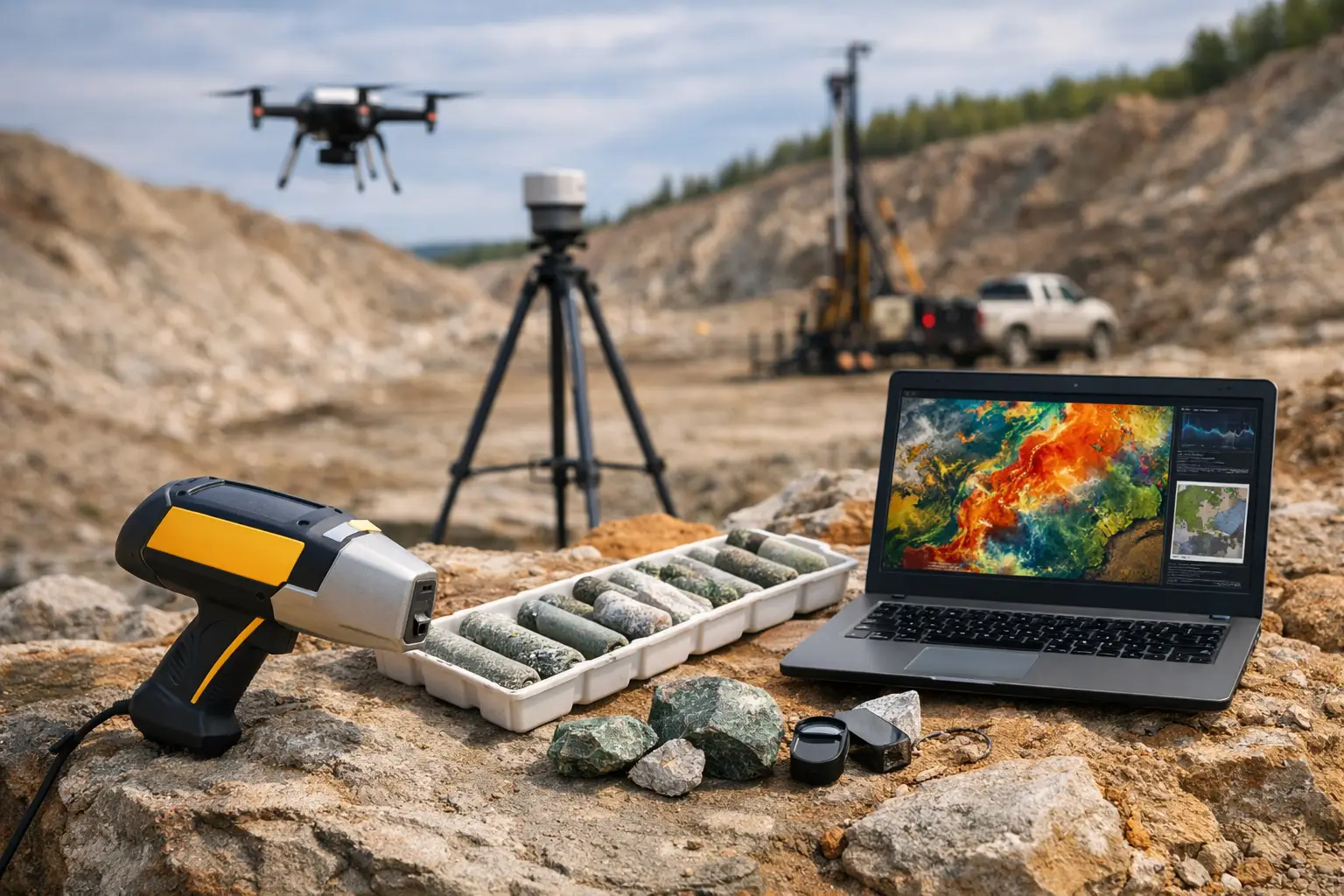
Multi-sensor projects require another layer of discipline. If LiDAR, orthomosaic, magnetic, and electromagnetic outputs are being fused into a single interpreted product, each data stream must first pass its own validation gate. Fusion before validation can mask source-specific errors and contaminate interpretation. A cross-validated workflow keeps lineage intact so each derived conclusion remains traceable back to calibrated source measurements.
Documentation is what makes the workflow auditable
Technical quality is only part of acceptance. Institutional buyers, regulators, and engineering teams also need documentation that shows how quality was achieved. A fully auditable workflow records calibration dates, control methods, field conditions, equipment configuration, reflight decisions, processing parameters, residual statistics, and any deviations from the survey plan.
This record is not paperwork for its own sake. It protects project stakeholders when datasets are used for investment screening, mine planning, utility routing, groundwater targeting, or infrastructure design. If a question emerges months later about positional confidence, anomaly continuity, or processing corrections, the audit trail should provide an exact answer rather than a general assurance.
This is where specialist operators distinguish themselves. Air Solutions, for example, structures QA/QC around traceable acquisition records and cross-validated deliverables because high-value industrial programs cannot rely on black-box outputs. The client is not buying imagery or geophysical traces alone. The client is buying defensible intelligence.
Where workflows commonly break down
Most failures are procedural, not theoretical. Teams skip recalibration after payload changes. They accept marginal GNSS quality because the aircraft is already airborne. They treat repeat lines as optional when weather pressure builds. They validate only final maps rather than raw and intermediate products. Or they use generic acceptance thresholds that do not match the decision context.
Another common issue is over-processing. Aggressive smoothing, leveling, or interpolation can make products look cleaner while reducing interpretive integrity. For executive stakeholders, cleaner graphics may appear favorable. For technical evaluators, they can be a warning sign. A disciplined workflow preserves signal, quantifies uncertainty, and documents every correction applied.
Why this matters at project and portfolio scale
For one survey, calibration and validation protect a dataset. Across a portfolio, they protect capital allocation. When exploration targets, engineering alignments, hazard assessments, or water resource decisions are built on airborne data, the workflow behind that data becomes a governance issue as much as a technical one.
That is why experienced buyers should ask not only what sensors are being deployed, but how calibration is executed, how validation is separated from calibration, what independent checks are used, and what evidence will accompany final delivery. Those questions usually reveal whether a contractor is running a controlled measurement program or simply flying equipment.
A reliable survey is not defined by the sophistication of the payload alone. It is defined by whether every stage - planning, field calibration, in-flight QA/QC, processing, and final validation - produces data that can stand up to technical scrutiny long after the aircraft has left site. That is the standard worth insisting on when the output will shape real-world decisions.