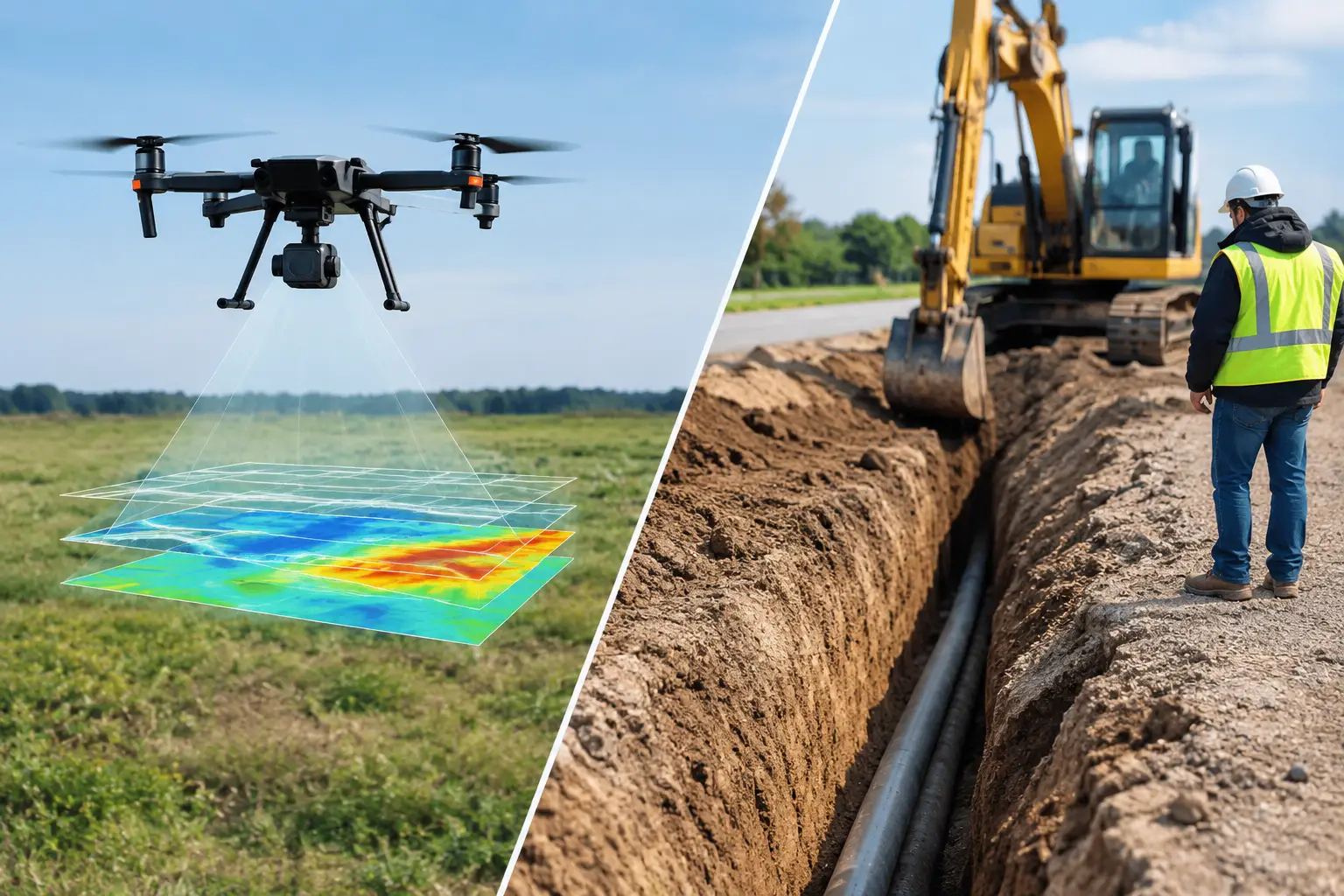
Procurement failures in geospatial work rarely begin with price. They begin when a vendor looks technically capable on paper but cannot produce decision-grade outputs under real operating constraints. That is the core issue in how to evaluate geospatial vendors: not whether they own sensors, but whether they can execute a calibrated, auditable, and project-specific survey program that stands up to engineering, regulatory, and investment scrutiny.
For mining, water, utilities, energy, and major infrastructure programs, vendor evaluation has to move beyond a generic capabilities checklist. A drone operator, mapping firm, or airborne survey provider may present strong marketing language and broad service menus, yet still fall short on sensor selection, environmental tolerance, data processing discipline, or interpretive depth. Buyers need a framework that tests operational maturity as hard as technical capability.
How to evaluate geospatial vendors against project risk
The first filter is alignment with the actual decision you need to make. A vendor that is strong in topographic mapping may not be qualified for groundwater targeting, utility detection, radiometric interpretation, or airborne geophysics. The relevant question is not, "Can they collect data?" It is, "Can they collect and interpret the right data for this asset, terrain, and decision context?"
That distinction matters because geospatial projects fail in specific ways. Resolution may be insufficient for the target. Positioning accuracy may degrade in difficult terrain. A LiDAR dataset may be technically clean but operationally useless if the classification schema does not support engineering design. An aeromagnetic survey may be well flown but poorly leveled, making structural interpretation unreliable. Evaluation should therefore begin with the intended output: terrain model, anomaly map, utility corridor risk layer, structural geology interpretation, volumetric estimate, or inspection intelligence.
A serious vendor will translate your business objective into survey design logic. They should explain why a specific sensing stack, flight plan, line spacing, altitude, ground control strategy, and processing workflow are appropriate. If they default to a standard package without showing technical rationale, that is a warning sign.
Start with sensing fit, not service breadth
Many firms present themselves as full-service geospatial providers. Breadth can be useful, but it is not proof of competence. In high-value projects, sensing fit matters more than the size of the menu.
A technically disciplined evaluation should ask whether the vendor can justify the sensing modality against the target problem. Photogrammetry may be efficient for surface modeling in good visual conditions, but not sufficient where vegetation penetration, low-texture surfaces, or precise elevation performance are required. LiDAR may solve that issue, but only if the platform, point density, calibration, and boresight control are adequate. Electromagnetic or magnetic methods may be highly effective for subsurface targeting, but only when survey parameters are designed around geology, conductivity contrasts, and noise conditions.
This is where enterprise buyers should press for specificity. Ask what sensor platform will be deployed, what accuracy class is expected, what environmental constraints affect acquisition, and what minimum detectable feature size or depth range the method can realistically support. Experienced vendors answer in operational terms, not slogans.
QA/QC is the real dividing line
If there is one area that separates credible providers from presentation-ready ones, it is QA/QC. Data acquisition without traceable quality control is only expensive field activity.
A vendor worth considering should be able to document calibration routines, positional control methodology, line verification procedures, repeatability checks, environmental compensation, processing logs, and acceptance thresholds. For airborne geophysics, that may include tie-line analysis, heading checks, noise filtering logic, and leveling controls. For LiDAR and photogrammetry, it may include checkpoint validation, boresight calibration, residual analysis, and classification accuracy review. For interpreted outputs, it should include peer review and cross-validation against known controls or existing datasets.
Ask to see how quality is evidenced, not just claimed. The strongest firms can show audit trails from acquisition through final deliverable. They can explain where uncertainty enters the workflow and how it is managed. That matters because procurement teams are not just buying maps or datasets. They are buying defensibility.
Evaluate the deliverable, not only the raw data
One of the most common mistakes in vendor selection is overvaluing raw sensor output and undervaluing interpretive usefulness. In many sectors, raw data is not the final product. The real requirement is an engineering-ready, exploration-ready, or planning-ready deliverable.
That means vendor evaluation should include the structure and usability of the final output. Will you receive a point cloud, orthomosaic, and geotagged files that your team still has to interpret internally? Or will you receive a decision-oriented package with classified surfaces, anomaly rankings, interpreted targets, corridor constraints, volumetric calculations, and sector-specific reporting?
The answer depends on internal capability. If your organization has a mature geospatial and geoscience team, raw or lightly processed data may be enough. If not, then the vendor’s interpretive layer becomes central. There is no universal right model, but there is a wrong one: paying for data that your team cannot operationalize fast enough.
Vendors should also be evaluated on file formats, metadata discipline, coordinate reference handling, revision control, and integration with GIS, CAD, BIM, or geological modeling environments. These details rarely appear in top-line proposals, yet they determine whether outputs are usable on day one.
Mobilization speed matters, but only with control
For remote and time-sensitive projects, buyers often prioritize speed. That is reasonable, especially when field windows are short or project delays are expensive. Still, speed without process control creates hidden risk.
A credible geospatial vendor should be able to explain mobilization timelines, field crew composition, equipment redundancy, permitting readiness, and contingency planning. In Saudi and Gulf operating conditions, heat load, dust, remoteness, and logistics discipline are not side issues. They directly affect acquisition quality and program continuity.
This is where operational maturity becomes visible. Can the vendor maintain calibration and quality standards under desert conditions? Do they have backup systems if a payload fails? Can they execute confined-space or hard-access inspections safely? Can they scale from pilot survey to larger deployment without changing methodology midway? Buyers should treat these as core evaluation criteria, not secondary logistics questions.
How to evaluate geospatial vendors on compliance and governance
The next test is governance. Geospatial data often touches regulated airspace, critical infrastructure, environmental reporting, and government stakeholders. A vendor may be technically strong yet commercially risky if compliance is weak.
Ask how they manage flight permissions, site access protocols, HSE documentation, data custody, and reporting control. For public sector or strategic infrastructure work, data handling may be as important as collection quality. You need clarity on storage, access control, transfer procedures, and whether the workflow supports client confidentiality and audit requirements.
For larger buyers, commercial governance also matters. Review subcontracting exposure, insurance position, project management structure, escalation paths, and contractual accountability for rework. A disciplined vendor should be comfortable discussing these controls in detail.
Past performance should match your operating environment
Case studies can be misleading if they are too general. A vendor may have completed dozens of surveys, yet none under conditions that resemble your project.
Look for past performance in comparable terrain, climate, asset type, and decision context. A successful urban facade inspection program does not automatically translate into competence in regional mineral targeting. A mapping provider with strong agricultural coverage may not be prepared for utility detection around congested industrial assets. Relevance matters more than volume.
When reviewing references or project examples, focus on constraints. What was the environment? What was the sensing objective? What quality thresholds had to be met? What downstream decision depended on the output? Vendors with genuine execution depth can speak clearly about what made a project difficult and how they controlled for it.
That level of transparency is often more valuable than polished success language. Firms operating at the standard of Air Solutions, for example, tend to frame capability through methodology, controls, and sector applicability rather than broad promotional claims.
Price should be read in context
Low-cost geospatial procurement often becomes high-cost remediation. Reflight campaigns, inconsistent datasets, poor interpretive quality, and delayed engineering decisions quickly erase any saving achieved at contract award.
That does not mean the highest bid is best. It means price should be assessed against scope completeness, QA/QC discipline, interpretive value, field risk reduction, and the cost of downstream error. In some cases, a lower-cost provider is the right choice for a simple visual survey or limited orthomosaic update. In others, especially where subsurface targeting, asset integrity, or capital planning is at stake, underbuying creates avoidable exposure.
A strong procurement process compares vendors on technical sufficiency first and commercial efficiency second. That sequence prevents false economy.
The best geospatial vendors do not just promise data capture. They show how their workflow produces calibrated, traceable, and decision-ready outputs under the actual conditions your project will face. If a vendor can prove that standard before contract award, the procurement conversation becomes much simpler.