A drilling program can miss the target for one simple reason: the subsurface model was wrong before the first rig arrived. That is where aeromagnetics earns its value. If you are asking what is an aeromagnetic survey, the short answer is this: it is an airborne geophysical method that measures variations in the Earth's magnetic field to map subsurface geology, structures, and buried features at scale.
For technical buyers, that definition is only the starting point. The real value of an aeromagnetic survey is not the sensor itself. It is the ability to convert calibrated magnetic measurements into decision-grade geological intelligence that can guide exploration, de-risk infrastructure routing, support groundwater investigations, and improve targeting before more expensive fieldwork begins.
What is an aeromagnetic survey used for?
An aeromagnetic survey is used to detect magnetic contrasts in rocks and near-surface materials. Different lithologies contain different concentrations of magnetic minerals, primarily magnetite and, in some cases, pyrrhotite or other ferromagnetic components. When an aircraft or drone carries a magnetometer across a survey area, the instrument records small changes in magnetic intensity. Those changes can be processed into maps that reveal faults, dikes, basement structures, alteration zones, buried channels, and other features that may not be visible at the surface.
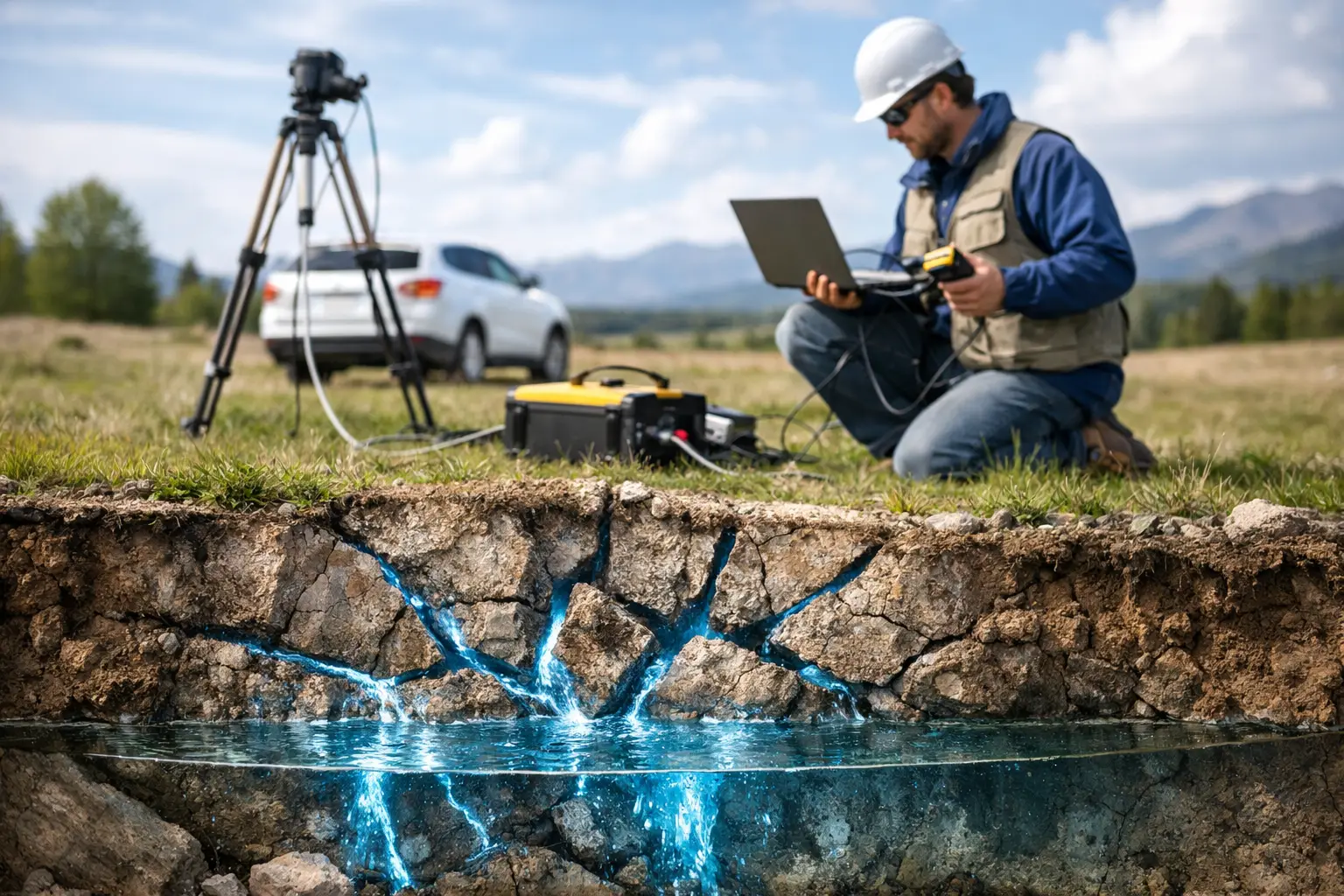
In mineral exploration, this helps define structural controls, map greenstone belts, locate intrusive bodies, and refine drill targeting. In groundwater and engineering contexts, the same method can help delineate basement topography, identify fracture systems, and detect buried infrastructure or geologic boundaries relevant to construction risk. The method is indirect, which matters. It does not produce a literal image of the subsurface. It produces a magnetic response that must be processed, modeled, and interpreted by geophysicists in context with geology and other datasets.
How an aeromagnetic survey works
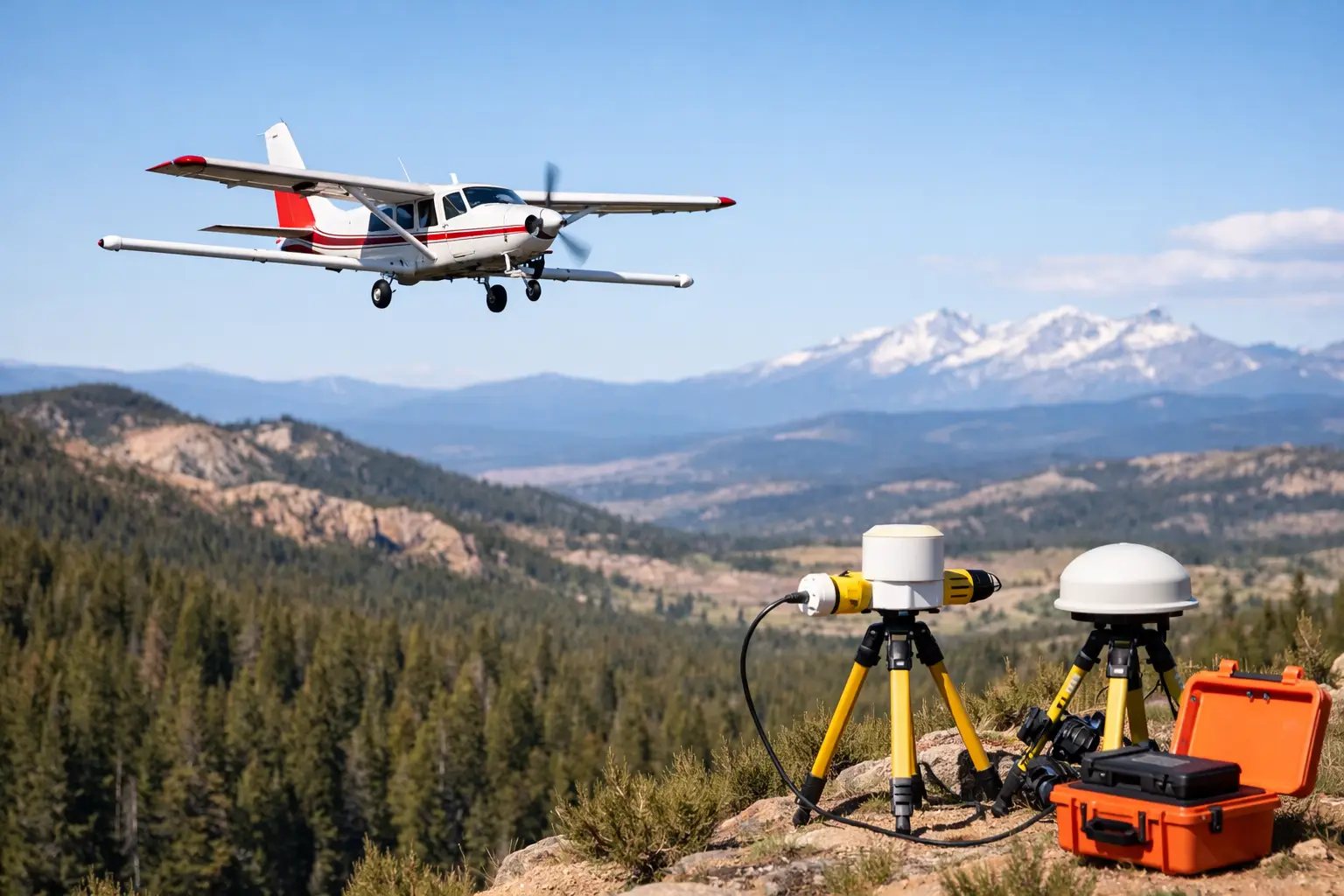
The operating principle is straightforward. A calibrated magnetometer is flown along pre-planned survey lines at controlled spacing and altitude. As the platform moves, the system records total magnetic intensity along with high-accuracy positional data from GNSS and, where required, inertial measurements for trajectory correction.
The practical execution is more demanding than the principle suggests. Data quality depends on line spacing, terrain clearance, platform stability, heading control, magnetic compensation, diurnal correction, and rigorous QA/QC. Survey design is driven by the target. A regional structural program may tolerate wider line spacing and higher altitude. A near-surface engineering or mineral targeting program usually requires tighter spacing and lower, more controlled flight paths to resolve shorter-wavelength anomalies.
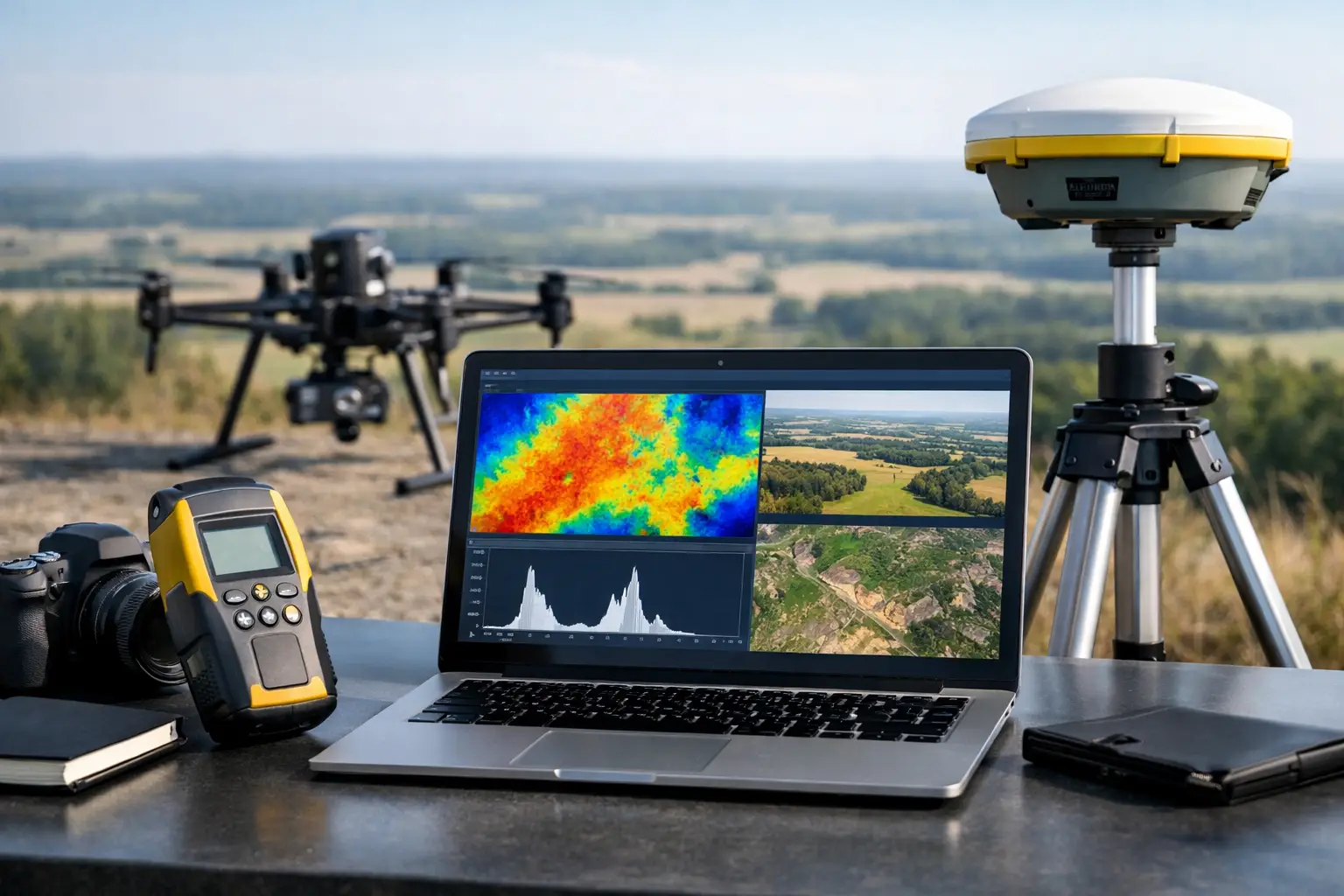
Once acquired, the raw magnetic data is corrected for temporal field variations and survey noise, leveled between lines, and processed into usable products. Depending on the objective, deliverables may include total magnetic intensity grids, reduced-to-pole products, first vertical derivatives, analytic signal, tilt derivative, and 2D or 3D inversion outputs. These are not cosmetic maps. They are technical layers used to support interpretation and downstream decisions.
What the data actually tells you
Aeromagnetic data is most powerful when it clarifies geometry. It can show where magnetic domains begin and end, where structures offset lithologies, and where concealed bodies may sit below cover. In many terrains, it is one of the fastest ways to map bedrock architecture over large areas.
That said, magnetic response is not the same as geology in a one-to-one sense. A strong anomaly may indicate a mafic intrusion, a magnetite-rich horizon, cultural interference, or remanent magnetization effects that complicate direct interpretation. A weak response does not mean geological insignificance. Some economically important units are magnetically quiet. This is why aeromagnetic data should be integrated with geology, radiometrics, electromagnetics, gravity, drilling, or surface mapping rather than treated as a standalone truth source.
For enterprise and government clients, this distinction matters commercially. A survey that is fast but poorly interpreted can create false confidence. A properly executed program produces traceable, cross-validated outputs that reduce uncertainty instead of shifting it downstream.
Why airborne methods are favored over ground magnetics
Ground magnetic surveys still have a place, especially for site-specific follow-up. But for large concessions, corridor mapping, regional groundwater programs, and early-stage target generation, airborne acquisition is often more efficient. It covers more area in less time, accesses difficult terrain without extensive field crews, and produces more consistent regional datasets.
Drone-based aeromagnetic systems extend those advantages further in areas where manned aircraft are too costly, too logistically heavy, or unsuitable for low-altitude operations. That is particularly relevant in remote desert environments, infrastructure corridors, and compact project areas where rapid mobilization and controlled line spacing are critical.
There are trade-offs. Drones generally have lower endurance and smaller payload envelopes than manned platforms, so survey planning must be disciplined. Weather windows, communications, aviation permissions, and battery logistics all affect execution. But when the mission is engineered correctly, drone aeromagnetic acquisition can deliver high-resolution data with strong safety and cost advantages.
What determines survey quality
Not all aeromagnetic surveys are equal, even when the maps look similar at first glance. Quality is determined by a chain of technical controls, beginning with sensor selection and magnetic cleanliness of the platform. If the aircraft itself introduces magnetic noise, the final dataset will carry that contamination no matter how polished the presentation looks.
Flight design is the next control point. Line spacing, tie-line layout, heading strategy, terrain following, and altitude consistency directly affect anomaly resolution and leveling performance. Lower altitude usually improves resolution, but only if the platform can maintain stable and safe terrain clearance. In rugged or built-up environments, aggressive low flying may not be operationally realistic.
Processing discipline matters just as much as acquisition discipline. Diurnal correction, IGRF removal, lag correction, despiking, micro-leveling, and final gridding all need to be documented and auditable. For high-value industrial or government work, the client should be able to trace how raw observations became final interpreted deliverables.
Where aeromagnetic surveys create the most value
The strongest business case for aeromagnetics appears when decision speed and area coverage both matter. In mining, the method supports reconnaissance, target generation, structural interpretation, and brownfield extension work. In water resource programs, it can help define basement configuration and fault architecture that influence groundwater occurrence and movement. In infrastructure and utilities, it supports route selection, geohazard screening, and buried feature mapping before design advances too far.
It is also highly effective as part of a multi-sensor workflow. Magnetic data combined with electromagnetic, LiDAR, hyperspectral, or radiometric datasets provides a more complete model than any single method alone. That integration is where modern airborne geoscience has moved. Clients are no longer buying isolated measurements. They are buying interpreted intelligence that can survive technical scrutiny, procurement review, and board-level capital decisions.
What is an aeromagnetic survey not good at?
This is where procurement teams should ask harder questions. Aeromagnetic surveys are excellent for mapping magnetic contrasts, but they are not universal. They will not directly measure grade, porosity, water quality, or geotechnical strength. They are less informative in areas where the geology has minimal magnetic contrast, and they can be distorted by cultural noise from fences, pipelines, power lines, vehicles, or industrial installations.
Interpretation can also become more complex in regions affected by remanent magnetization, where anomaly position and polarity do not behave as simple induced models would predict. In those cases, advanced processing and experienced interpretation are not optional. They are required to avoid mis-targeting.
That is why scope definition matters. The right question is not whether aeromagnetics works in general. It is whether aeromagnetics is the right method for this geological problem, at this scale, with this expected resolution, and this decision deadline.
Choosing a survey partner
For buyers evaluating vendors, the technical differentiator is rarely the claim of owning a magnetometer. The differentiator is whether the provider can design the survey around the business objective, operate safely in the project environment, maintain magnetic and positional quality, and deliver interpreted outputs that align with the client's reporting standards.
A credible provider should be able to explain line design, terrain strategy, compensation approach, processing workflow, QA/QC gates, and how interpretation will be cross-validated against existing geology or adjacent datasets. If the answer stops at data capture, the service is incomplete. The survey has only created value when the output is usable by geologists, engineers, planners, and investment stakeholders.
For organizations operating in time-sensitive sectors, that combination of speed, traceability, and interpretation depth is what turns airborne magnetics from a technical survey into a decision tool. Air Solutions applies that model in drone-based programs where rapid mobilization, calibrated acquisition, and auditable geoscience outputs are essential.
An aeromagnetic survey is best understood as an early warning system for the subsurface. It does not replace drilling, trenching, or direct investigation. It tells you where those higher-cost actions should happen first, and where they should not. That is usually the difference between collecting more data and making better decisions.