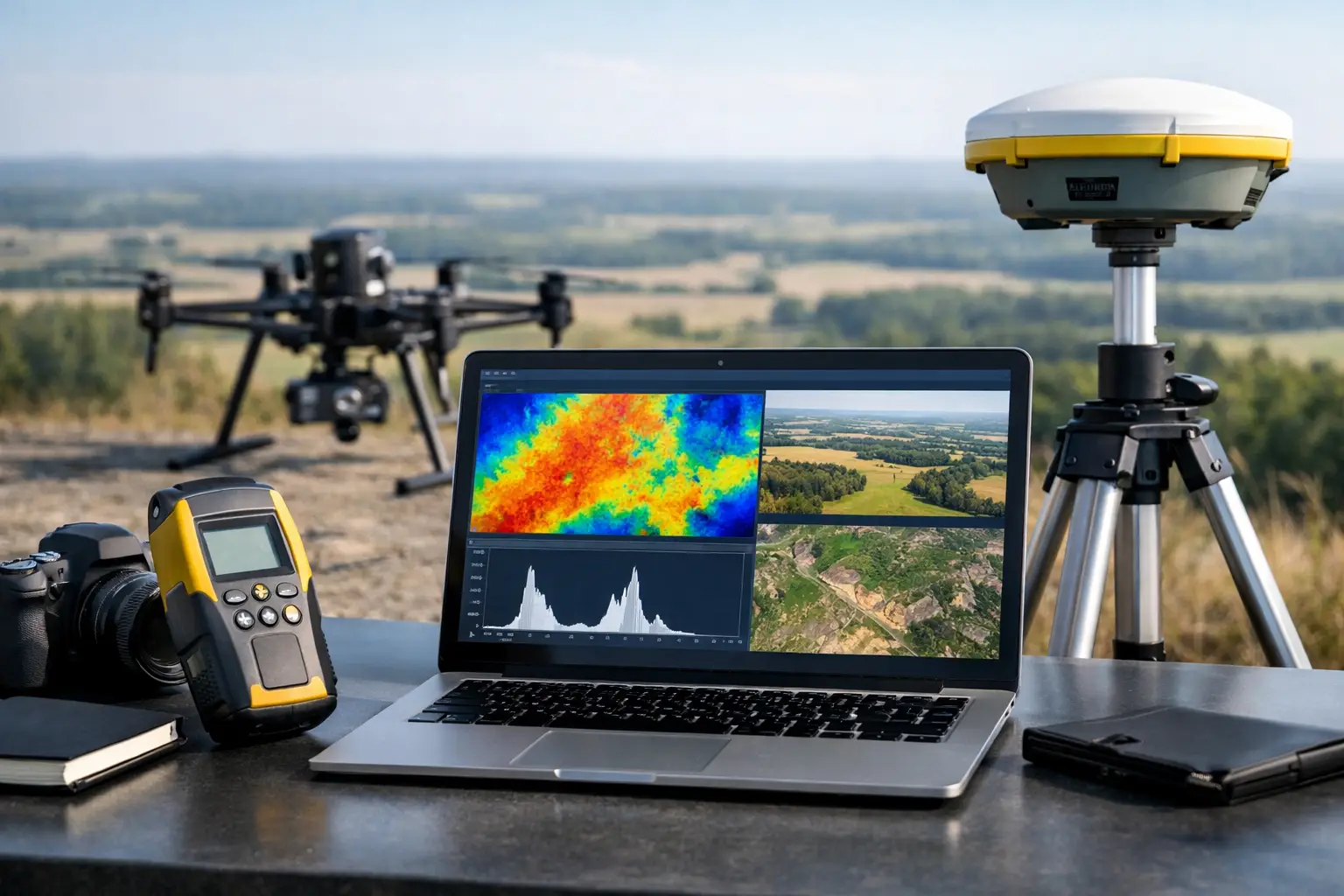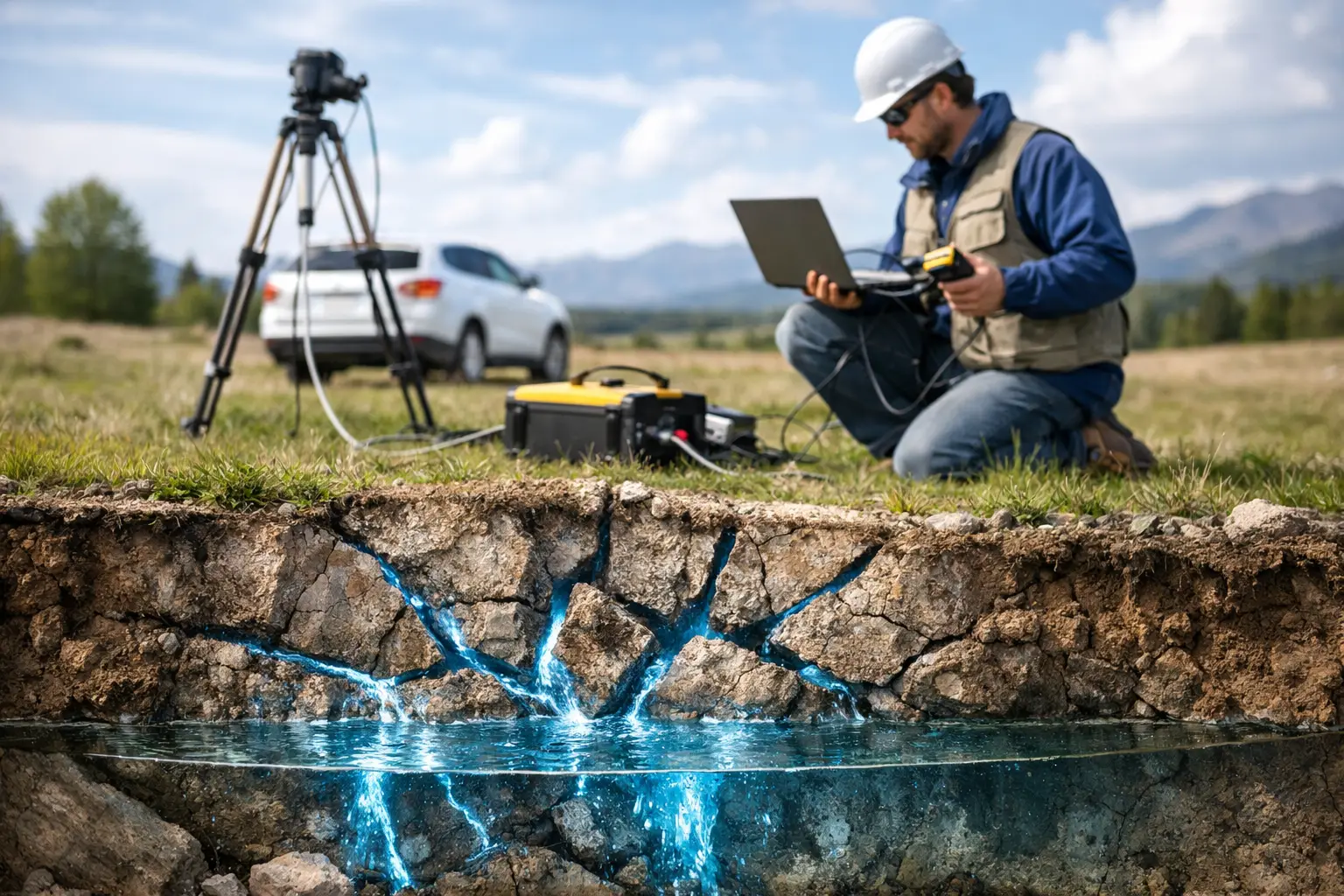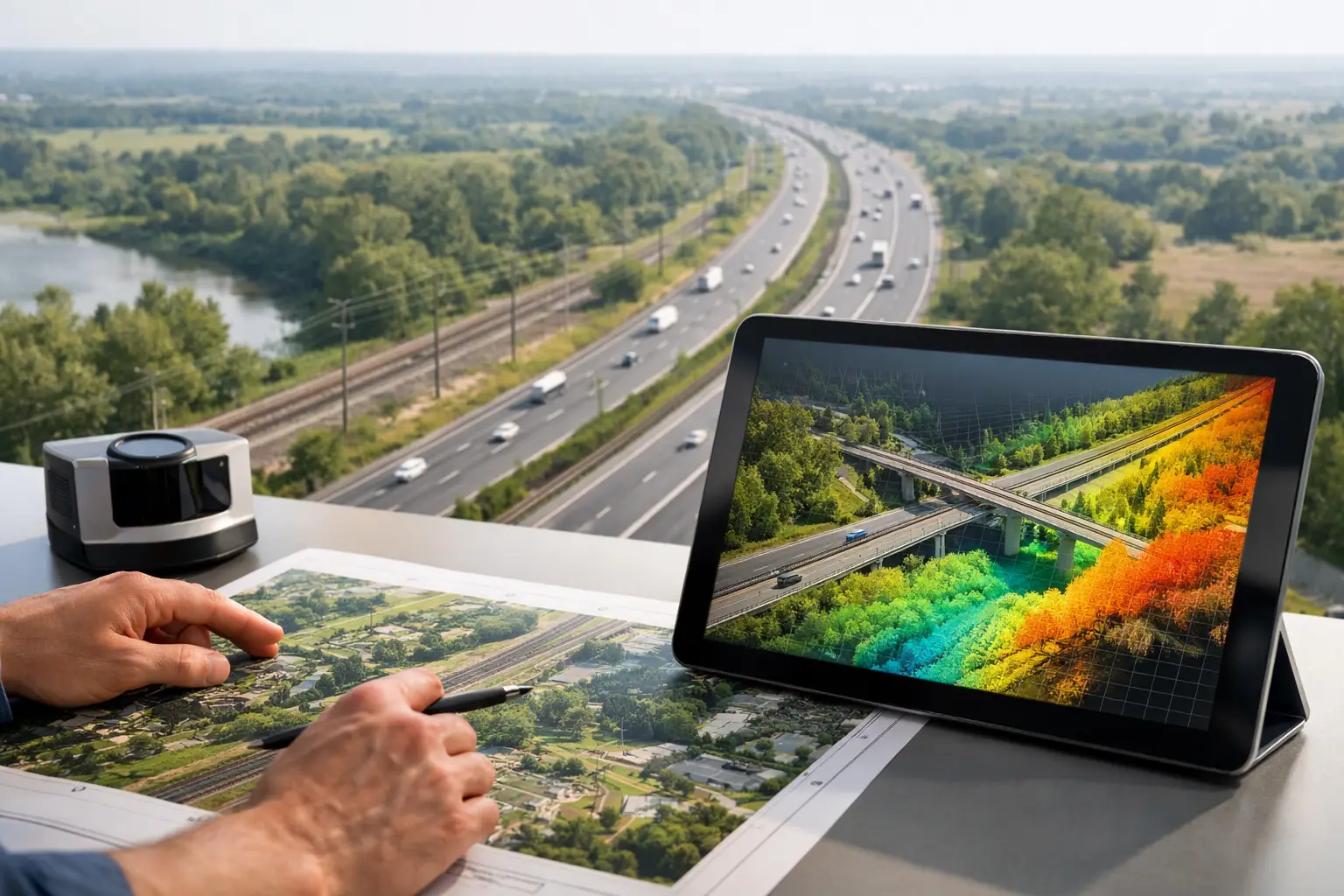
A corridor project is rarely constrained by one variable. A proposed route may cross unstable slopes, flood-prone ground, active utilities, transport assets, and restricted access zones within a few kilometers. That is exactly where how LiDAR supports corridor design becomes commercially and technically significant. It gives engineering and planning teams a calibrated terrain model early enough to reduce route risk before design assumptions become expensive.
For linear infrastructure such as roads, pipelines, transmission lines, rail alignments, canals, and utility corridors, the quality of the base spatial dataset determines the quality of every downstream decision. If the terrain model is sparse, outdated, or stitched together from inconsistent sources, the design process absorbs that uncertainty. LiDAR changes that by producing high-density elevation and surface information that can be measured, classified, audited, and integrated into design workflows with far more control than conventional topographic methods alone.
How LiDAR supports corridor design in early-stage planning
At the planning stage, corridor design is an exercise in constraint management. Teams need to evaluate route alternatives against terrain, drainage, land use, environmental sensitivity, access, constructability, and future maintenance requirements. LiDAR improves this process because it captures continuous elevation data across the full route envelope rather than isolated points collected at intervals.
That continuity matters. In preliminary route selection, small topographic features can drive major cost differences. A shallow drainage channel, an embankment break, a subtle ridgeline, or a low-lying flood path may not appear clearly in coarser mapping. LiDAR-derived digital terrain models expose those details, allowing planners to compare alignments with more confidence before committing to field-intensive design phases.
For enterprise buyers, the benefit is not just better visualization. It is earlier cost discipline. When route options are evaluated using defensible elevation data, cut-and-fill assumptions, access planning, and structure placement become more realistic. That reduces redesign cycles and improves internal approvals, particularly on projects where procurement, environmental review, and engineering sign-off depend on traceable geospatial evidence.
Terrain intelligence, not just topography
LiDAR is often reduced to a topographic survey tool, but in corridor design its value is broader. A well-executed LiDAR campaign can support bare-earth modeling, surface modeling, slope analysis, cross sections, breakline extraction, drainage interpretation, and visibility into man-made features along the route. This creates a stronger technical basis for alignment optimization.
For road and rail corridors, grade control is a primary design driver. LiDAR provides the elevation density needed to model longitudinal profiles and crossfall behavior with far greater resolution than a sparse ground survey. For transmission and pipeline projects, terrain continuity supports structure spacing, line-of-sight assessment, access track planning, and identification of sections where earthworks or special engineering controls may be required.
The practical effect is speed with fewer assumptions. Design teams are not forced to interpolate across large gaps in the source data. They can work from a measured surface that is suitable for engineering analysis and can be revisited during QA/QC if a design decision is challenged later.
Why density and classification matter
Not all LiDAR outputs are equal. For corridor design, point density, vertical accuracy, classification quality, and control methodology directly affect whether the dataset is decision-grade. A dense point cloud without disciplined ground classification can create false confidence, especially in vegetated areas, urban fringes, or mixed industrial settings.
Ground, vegetation, buildings, and infrastructure returns must be properly classified to generate reliable terrain and surface models. If that classification is weak, the resulting profiles can distort clearance calculations, drainage paths, and earthwork quantities. This is why corridor LiDAR should be treated as an engineered measurement program, not simply an aerial data collection exercise.
How LiDAR supports corridor design where access is difficult
Many corridor projects cross environments where conventional survey is slow, hazardous, or operationally disruptive. Desert terrain, escarpments, wadis, pipeline rights-of-way, active utilities, and transport corridors all introduce field access constraints. In these settings, drone-based LiDAR provides a safer and faster acquisition model while maintaining spatial control.
This is especially relevant in the Gulf, where extreme heat, remoteness, and large-area coverage requirements can extend survey schedules and increase exposure for field crews. Airborne LiDAR reduces the need for personnel to physically occupy every segment of the route while still delivering continuous terrain data. For project owners, that means faster mobilization and less operational friction around active assets or restricted zones.
There are trade-offs. Ground survey remains necessary for control, validation, and selected detail capture, particularly at tie-ins, structures, and locations with high design sensitivity. LiDAR does not replace all conventional methods. It changes the balance by shifting broad-area terrain capture into a faster, more controlled acquisition framework and reserving field crews for targeted verification.
Design decisions LiDAR improves
The clearest answer to how LiDAR supports corridor design is found in the decisions it sharpens.
Alignment selection improves because route alternatives can be tested against actual terrain behavior, not generalized contours. Earthwork estimation improves because the surface model is denser and more consistent across the full corridor width. Drainage design improves because subtle flow paths, depressions, and channel geometry are easier to model. Utility and structure planning improve because the surrounding surface and existing features are visible in spatial context.
These gains compound across the project lifecycle. A more accurate base model supports cleaner preliminary design, which supports more reliable stakeholder review, which reduces late-stage redesign. On major infrastructure programs, that sequence matters more than any single technical feature of the LiDAR sensor.
Cross sections and corridor width modeling
Corridor engineering depends heavily on repeatable cross sections. LiDAR enables frequent section generation across the route, which is valuable for identifying transition zones, embankment requirements, and terrain-driven constructability issues. Instead of relying on intermittent survey lines, engineers can analyze terrain continuously and generate additional sections wherever the design requires more scrutiny.
This is particularly useful when the corridor width is not fixed. Early design may begin with a broad route envelope and narrow over time as utilities, environmental setbacks, geotechnical constraints, and access requirements are resolved. LiDAR supports that iterative process because the source dataset covers the wider decision space from the start.
Integration with other corridor datasets
LiDAR is strongest when it is not operating alone. Corridor design often requires the integration of imagery, utility records, geotechnical data, hydrological models, cadastral constraints, and field observations. LiDAR provides the spatial framework that allows those datasets to be cross-referenced more reliably.
For example, orthophotos can help identify surface features, but without precise elevation they are limited for engineering. Utility records may indicate known assets, but LiDAR helps place them in topographic context. Hydrological assessment becomes more credible when based on a high-resolution terrain model rather than generalized elevation grids. In advanced workflows, multi-sensor fusion creates a richer corridor intelligence product than any single dataset can provide.
That is where experienced geospatial contractors create value. The client does not simply need a point cloud. The client needs processed, classified, validated outputs aligned to engineering and procurement decisions, with documentation that supports auditability and design traceability.
QA/QC is what makes LiDAR usable for engineering
For institutional buyers and EPC teams, the technical case for LiDAR only holds if the data is controlled. Corridor design is not served by visually impressive models that cannot withstand engineering review. The workflow must include survey control, sensor calibration, trajectory verification, classification checks, accuracy assessment, and deliverable-level QA/QC.
A fully auditable process is particularly important where corridor design feeds permitting, land acquisition, capital budgeting, or contractor claims. If a route decision depends on slope thresholds, flood exposure, or estimated earthworks, the underlying dataset must be defensible. That is why mature LiDAR programs document acquisition conditions, control methodology, processing parameters, and accuracy performance as part of the deliverable package.
For this reason, procurement teams should evaluate corridor LiDAR providers on methodology discipline as much as hardware capability. Sensor specifications matter, but execution maturity matters more.
Where LiDAR fits - and where it does not
LiDAR is highly effective for terrain-led corridor design, but it is not universal. Dense canopy, reflective surfaces, highly complex urban utility congestion, or subsurface uncertainty may require complementary methods. If the design problem is primarily underground, LiDAR alone will not resolve it. If the route passes through heavily built environments, additional terrestrial survey and utility detection may be required to achieve the necessary detail.
The correct approach is to define LiDAR as part of a survey architecture. Used this way, it gives corridor projects a high-quality terrain baseline, accelerates route screening, and improves engineering reliability without overstating what one sensor can do.
For project owners under schedule pressure, that is the real advantage. LiDAR does not simplify corridor design because the work is simple. It supports better decisions earlier, when route risk is still manageable and changes are still affordable. On complex infrastructure programs, that timing is often the difference between a controlled design phase and an expensive correction later.