
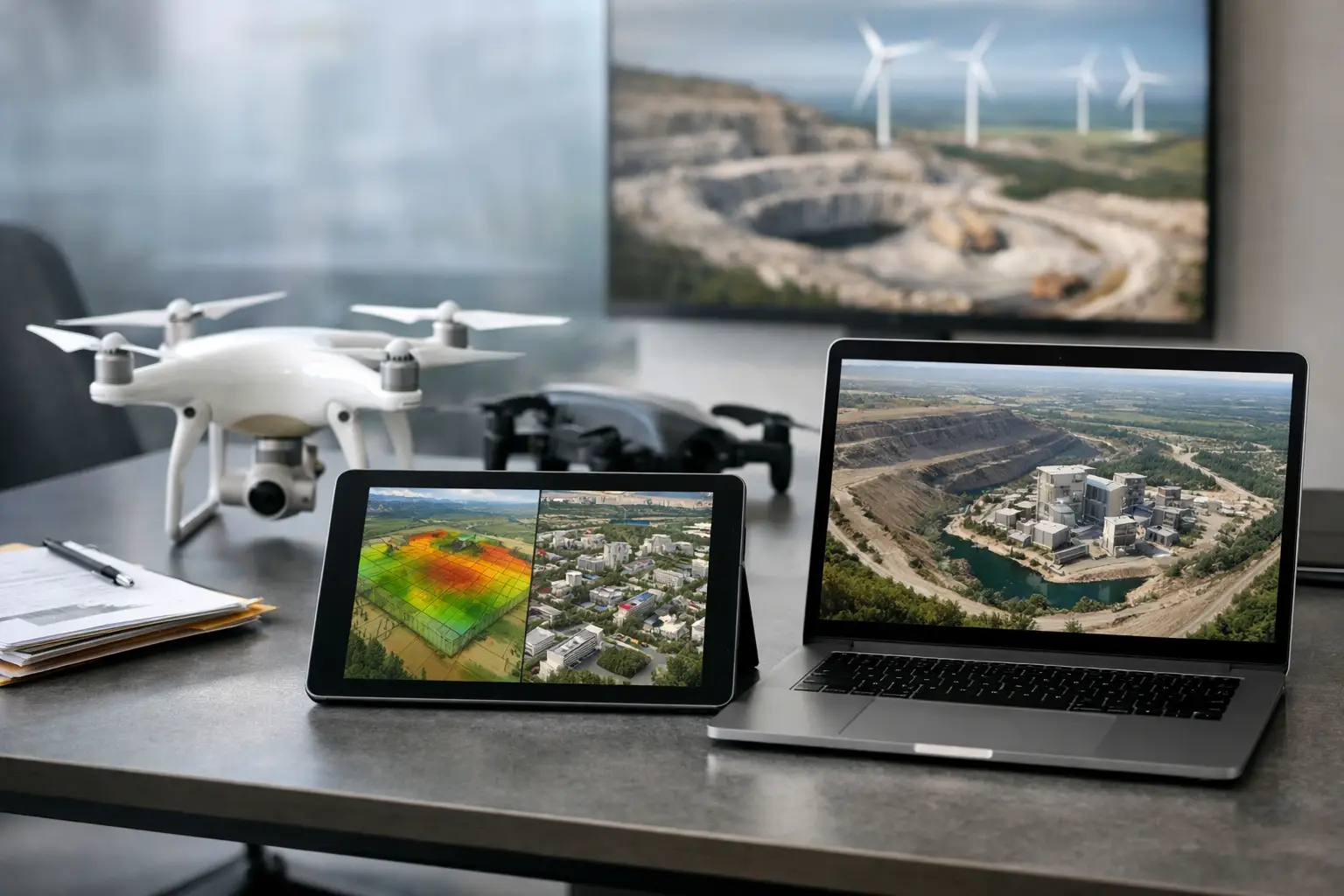
A procurement decision can fail long before the aircraft leaves the ground. In most industrial survey programs, the limiting factor is not the drone. It is the processing environment, the QA/QC chain, and the platform’s ability to convert field capture into decision-grade outputs. That is why a serious drone mapping platform comparison has to look past glossy orthomosaics and evaluate traceability, sensor compatibility, operating constraints, and how well the software holds up under engineering scrutiny.
For mining, utilities, water resources, corridor infrastructure, and government-led development programs, the platform is not just a visualization tool. It is part of the technical production line. If it cannot support calibrated workflows, auditable processing, repeatable accuracy checks, and structured deliverables, it becomes a bottleneck regardless of how polished the user interface appears.
What matters in a drone mapping platform comparison
Most comparisons focus on ease of use, subscription price, or how fast a model renders on screen. Those factors matter, but they are secondary in high-value industrial work. The first question is whether the platform can produce outputs that are defensible in planning, engineering, and compliance settings.
That means evaluating georeferencing controls, support for ground control points and checkpoints, bundle adjustment transparency, coordinate system handling, vertical datum management, and the ability to document every processing step. A platform that is acceptable for marketing imagery or a simple site-progress map may not be acceptable for volumetrics, topographic extraction, drainage assessment, or pre-construction design support.
The second issue is sensor reality. Many software environments perform well with standard RGB photogrammetry and begin to narrow once the project requires LiDAR, multispectral, thermal, or fused datasets. Industrial operators rarely stay inside one modality for long. A mine site may require terrain, stockpile, lineament, and infrastructure condition data in the same operating window. A water exploration program may need orthomosaic context, elevation modeling, and interpreted subsurface indicators tied into one reporting package. The platform does not need to do everything natively, but it does need to fit a broader data architecture.
The main categories of platforms
A useful drone mapping platform comparison starts by separating platforms into three practical categories.
Cloud-first photogrammetry platforms
These platforms prioritize simple upload, automated processing, and rapid sharing. They are often strong for basic site mapping, visual progress documentation, and distributed stakeholder access. Their advantage is speed to first output and low training burden.
The trade-off is control. Cloud-first systems can restrict advanced parameter tuning, limit transparency in processing logic, and create data residency concerns for clients with strict information governance requirements. They may also struggle when projects involve weak connectivity, large raw datasets, or regulated environments where organizations need tighter custody over survey data.
Desktop photogrammetry suites
Desktop environments generally offer deeper control over image alignment, camera calibration, dense cloud generation, classification, and export settings. For technical teams, that control is often the difference between a visually acceptable product and a quantitatively reliable one.
The trade-off is operational overhead. Desktop suites require stronger in-house expertise, more computing resources, and tighter workflow discipline. They can produce excellent results, but only if the operator understands survey design, coordinate handling, and quality validation. In other words, the software does not replace method.
Enterprise geospatial ecosystems
These platforms sit closer to a full production environment than a single mapping tool. They may combine capture planning, processing, asset integration, analytics, user permissions, and reporting pipelines across multiple projects and teams.
For enterprise buyers, this category becomes attractive when mapping is not an isolated activity but part of a broader inspection, asset management, or digital engineering framework. The trade-off is cost, implementation complexity, and the possibility of paying for modules that add little value to a narrowly defined survey program.
Accuracy is not a marketing claim
In any drone mapping platform comparison, stated accuracy should be treated carefully. Software vendors often present ideal-case performance. Technical buyers should be asking how the platform manages control networks, what residuals are exposed to the user, how checkpoints are reported, and whether the workflow supports independent validation.
A platform that produces smooth surfaces quickly is not automatically survey-grade. Accuracy depends on flight design, overlap, terrain texture, camera quality, control placement, environmental conditions, and processing settings. Good software helps manage those variables. It does not eliminate them.
This is particularly relevant in desert and industrial environments, where low-texture terrain, heat shimmer, dust, repetitive surfaces, and high-reflectance materials can degrade image matching. Platforms that perform well in temperate demonstration sites may produce inconsistent outputs in harsher operating conditions unless the workflow is properly adapted.
Processing speed versus processing control
Fast turnaround matters. Mobilization windows are short, and project teams need data while conditions are still relevant. But speed has to be evaluated in context.
Automated processing platforms reduce labor and can be effective for recurring, standardized missions. They are well suited to frequent stockpile checks, straightforward earthworks tracking, and operational dashboards where consistency is more valuable than methodological flexibility.
By contrast, complex terrain, mixed land cover, vertical structures, or engineering-sensitive deliverables usually benefit from more operator control. If the platform allows only a black-box workflow, technical teams may have no reliable way to troubleshoot distortions, improve reconstruction quality, or document why a result should be trusted. In high-consequence projects, control usually outranks convenience.
Outputs, interoperability, and reporting discipline
The real test of a platform is not whether it can create an orthomosaic. It is whether the output package supports downstream use without friction. That includes DEMs, DSMs, contours, point clouds, mesh products, volumetric reports, classified surfaces, GIS-ready layers, CAD-compatible exports, and metadata that preserves processing lineage.
Interoperability matters because industrial survey data rarely stays inside one software environment. Geologists, hydrologists, planners, EPC teams, and government reviewers may all touch the final deliverables. If the platform makes export difficult, strips metadata, or uses proprietary structures that complicate integration, it adds hidden cost.
This is where specialist operators often outperform software-led workflows. A disciplined delivery model builds processing logs, accuracy statements, coordinate references, checkpoint reports, and interpretation notes into the product package itself. For clients, that creates a cleaner audit trail and reduces ambiguity once data enters engineering or regulatory review.
Security, governance, and deployment model
Enterprise buyers should treat platform deployment as a strategic issue, not an IT footnote. Cloud processing may be acceptable for some projects and unsuitable for others. National infrastructure, critical utilities, resource intelligence, and government-backed programs can carry strict requirements around hosting, access control, and data retention.
A platform may be technically capable and still fail procurement if its governance model is weak. Key questions include where data is processed, who can access raw and derived products, whether role-based permissions are mature, how versioning is tracked, and whether outputs can be archived in a fully auditable way.
For organizations operating in Saudi Arabia and the Gulf, this is not abstract. Data sensitivity, project confidentiality, and sovereign development priorities often require stronger control than a default commercial SaaS model provides.
Which platform type fits which use case?
If the requirement is fast visual mapping for site communication, a cloud-first platform may be sufficient. If the requirement is technical terrain modeling with stronger control over georeferencing and reconstruction, a desktop suite is often the better fit. If the requirement spans many assets, departments, and reporting chains, an enterprise ecosystem may justify its complexity.
The harder cases sit in the middle. A mining company may need rapid turnaround today, but also defensible topography for resource planning next quarter. A utility operator may start with corridor visualization, then need integrated condition assessment and asset traceability. In those cases, choosing a platform based only on current scope can force an expensive migration later.
That is why the best drone mapping platform comparison is tied to mission design, data governance, reporting obligations, and end-user decisions. The software should fit the operating model, not the other way around.
A better buying standard for technical teams
Buyers should ask vendors and service partners for evidence, not claims. Request sample deliverables with checkpoint reporting. Review coordinate handling. Test export compatibility with your GIS and CAD environment. Examine whether the workflow supports multi-sensor integration, not just RGB photogrammetry. Most of all, verify whether the platform helps produce interpreted, decision-ready outputs rather than pushing raw processing burden back onto your internal team.
For organizations working in high-temperature, logistically constrained, or regulation-sensitive environments, the platform must also support execution under field reality. That means stable processing pipelines, documented QA/QC, and methods that remain reliable when terrain, climate, and schedule pressure are not forgiving. This is the standard serious operators such as Air Solutions build around, because the client is not buying software access. The client is buying defensible geospatial intelligence.
The right platform is the one that disappears into a controlled workflow and leaves your team with data they can act on with confidence.