A groundwater program can lose months before a single production well is drilled. The delay usually starts with sparse control points, difficult access, or overreliance on legacy mapping that does not resolve subsurface variability at project scale. Drone groundwater exploration methods address that gap by collecting dense, calibrated geospatial and geophysical data quickly, with lower field exposure and far better coverage than most ground campaigns can sustain.
For project owners in mining, water resources, infrastructure, and regional development, the value is not the drone itself. The value is a faster path to defensible hydrogeological decisions. That means identifying recharge zones, structural controls, weathered horizons, paleochannels, fracture networks, and shallow conductivity contrasts with enough spatial confidence to guide drilling, reduce dry-hole risk, and support technical reporting.
What drone groundwater exploration methods actually include
The term covers several airborne sensing workflows, not one instrument or one dataset. In practice, the most effective programs combine topographic, structural, and near-surface geophysical inputs because groundwater occurrence is controlled by more than one variable.
A typical survey may integrate drone-based electromagnetic sensing, aeromagnetic data, LiDAR terrain mapping, high-resolution photogrammetry, and in some cases hyperspectral indicators related to moisture, clay alteration, or surface expressions of hydrogeological processes. Each method responds to a different part of the problem. Electromagnetics can map conductivity variations associated with saturated zones, clay-rich formations, or salinity changes. Magnetics can reveal faults, dikes, basement features, and structural lineaments that influence groundwater storage and flow. LiDAR and photogrammetry help define geomorphology, drainage, wadis, depressions, alluvial architecture, and access constraints.
Used separately, these datasets are informative. Used together, they become materially more useful because hydrogeological targeting depends on correlation, not single-sensor interpretation.
Drone electromagnetic methods for groundwater targeting
Among drone groundwater exploration methods, airborne EM is often the primary tool for early-stage aquifer mapping. The reason is straightforward. Electrical conductivity contrasts are frequently more diagnostic of groundwater conditions than surface appearance alone.
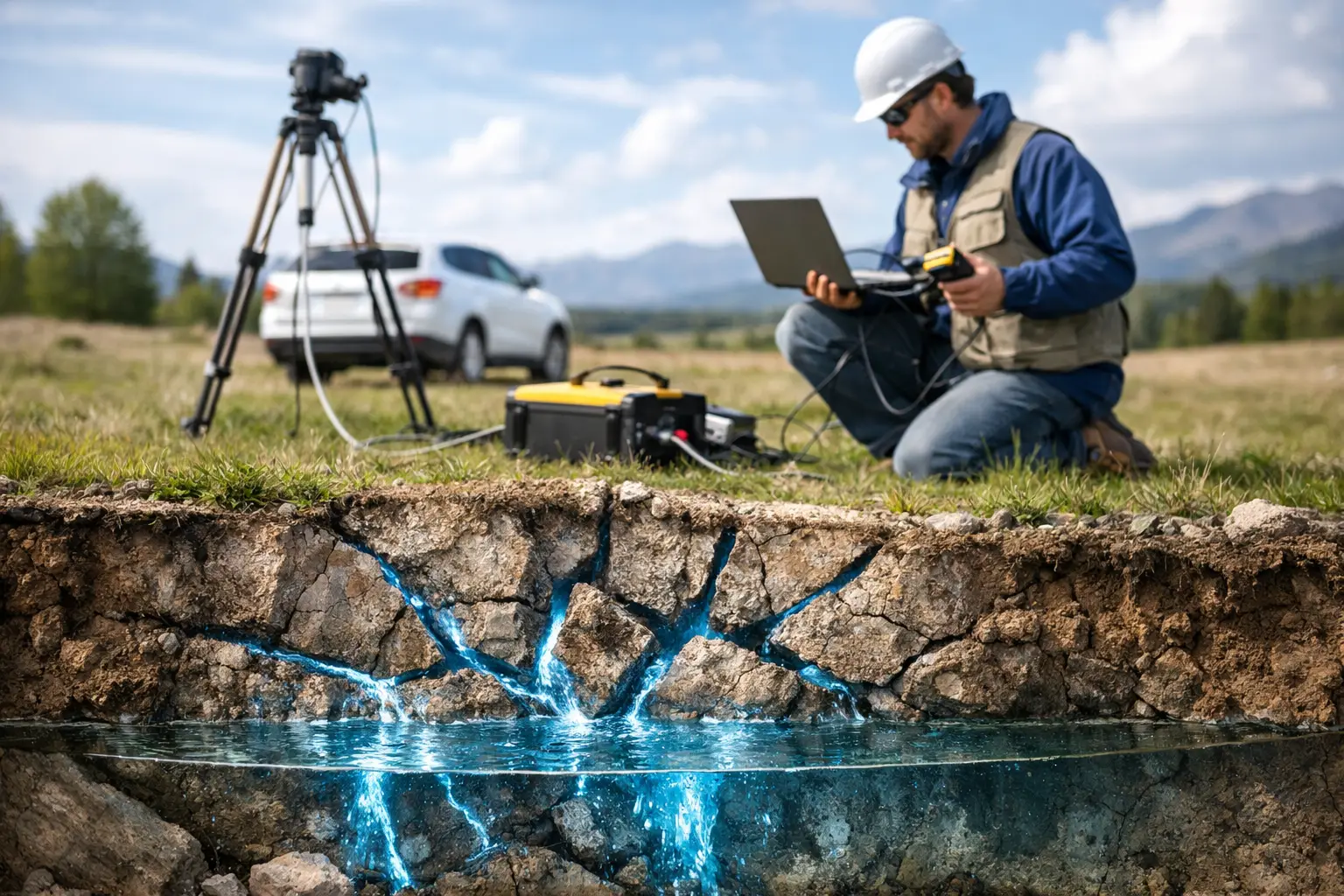
Drone EM systems transmit an electromagnetic field and measure the subsurface response. That response can indicate changes in lithology, depth to weathered bedrock, salinity distribution, moisture content, and the geometry of conductive bodies. In sedimentary basins, this can help delineate alluvial channels and saturated horizons. In hard-rock terrains, it may support mapping of weathered zones, faulted corridors, and fracture-controlled targets.
The trade-off is interpretation complexity. Conductivity is not a direct proxy for fresh groundwater. Clay can be conductive. Saline water can be highly conductive. Dry but mineralized zones can also distort the signal. That is why EM data should be cross-validated against geology, borehole logs, hydrochemistry, and any available ground resistivity or pumping data. The method is powerful, but only when framed correctly.
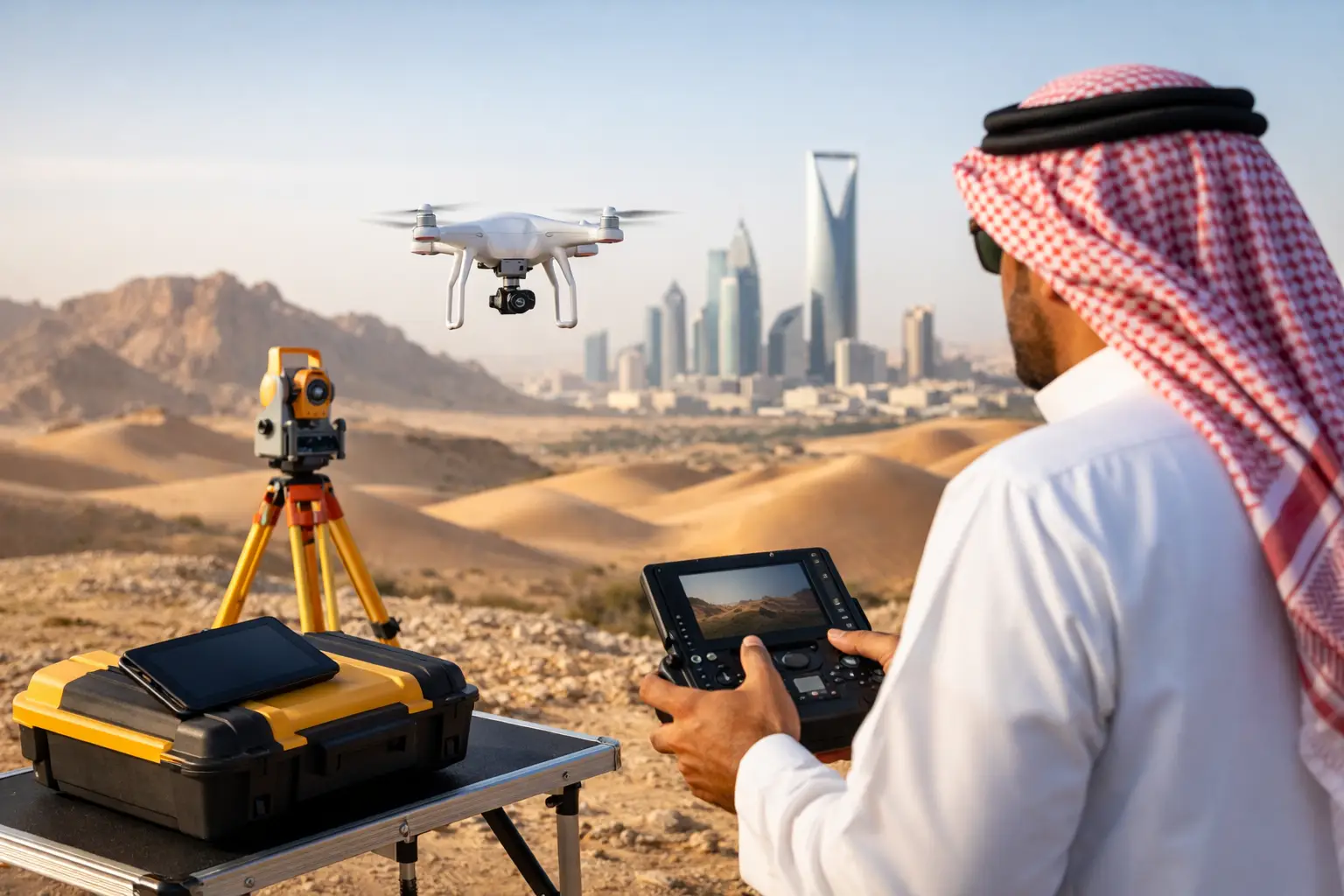
For desert operations, drone EM also has a practical advantage. It can cover difficult terrain without sending large crews across unstable ground, escarpments, or remote corridors where vehicle access is slow and field logistics become expensive.
The role of aeromagnetic data in groundwater models
Magnetics is sometimes misunderstood as a mining-only dataset. In groundwater work, it can be highly relevant where structural geology controls storage and transmissivity.
Faults, fracture corridors, buried channels, basement highs, and intrusive contacts can all shape groundwater movement. A high-resolution drone magnetic survey can detect subtle variations in magnetic susceptibility that help map those structural features at far better spatial resolution than many regional datasets. That becomes especially valuable where existing geological mapping is generalized or where surface cover obscures bedrock controls.
Magnetics does not tell you where water is sitting in a direct sense. It tells you where the framework exists for water accumulation, migration, or compartmentalization. In hard-rock aquifer exploration, that framework may be the difference between a productive target and an expensive dry well.
Why terrain and surface models still matter
Not every groundwater problem is solved below ground. Surface morphology often explains recharge behavior, runoff concentration, sediment transport, and the preservation of favorable depositional environments. That is where LiDAR and photogrammetry become more than mapping tools.
High-density terrain models can identify subtle channel relics, alluvial fan boundaries, flood pathways, karst expressions, lineament traces, and low-relief depressions that standard satellite basemaps miss. In wadis and ephemeral drainage systems, this level of detail can improve recharge assessment and support field planning for geophysical traverses, test pits, and drill access.
This matters operationally as well as scientifically. A technically sound target still fails as a project if the crew cannot mobilize safely, or if the selected drill locations create avoidable engineering issues. Terrain intelligence reduces those errors early.
Data fusion is where the method becomes decision-grade
The strongest groundwater interpretations rarely come from a single raster or anomaly map. They come from structured fusion of datasets with documented QA/QC and clear geological reasoning.
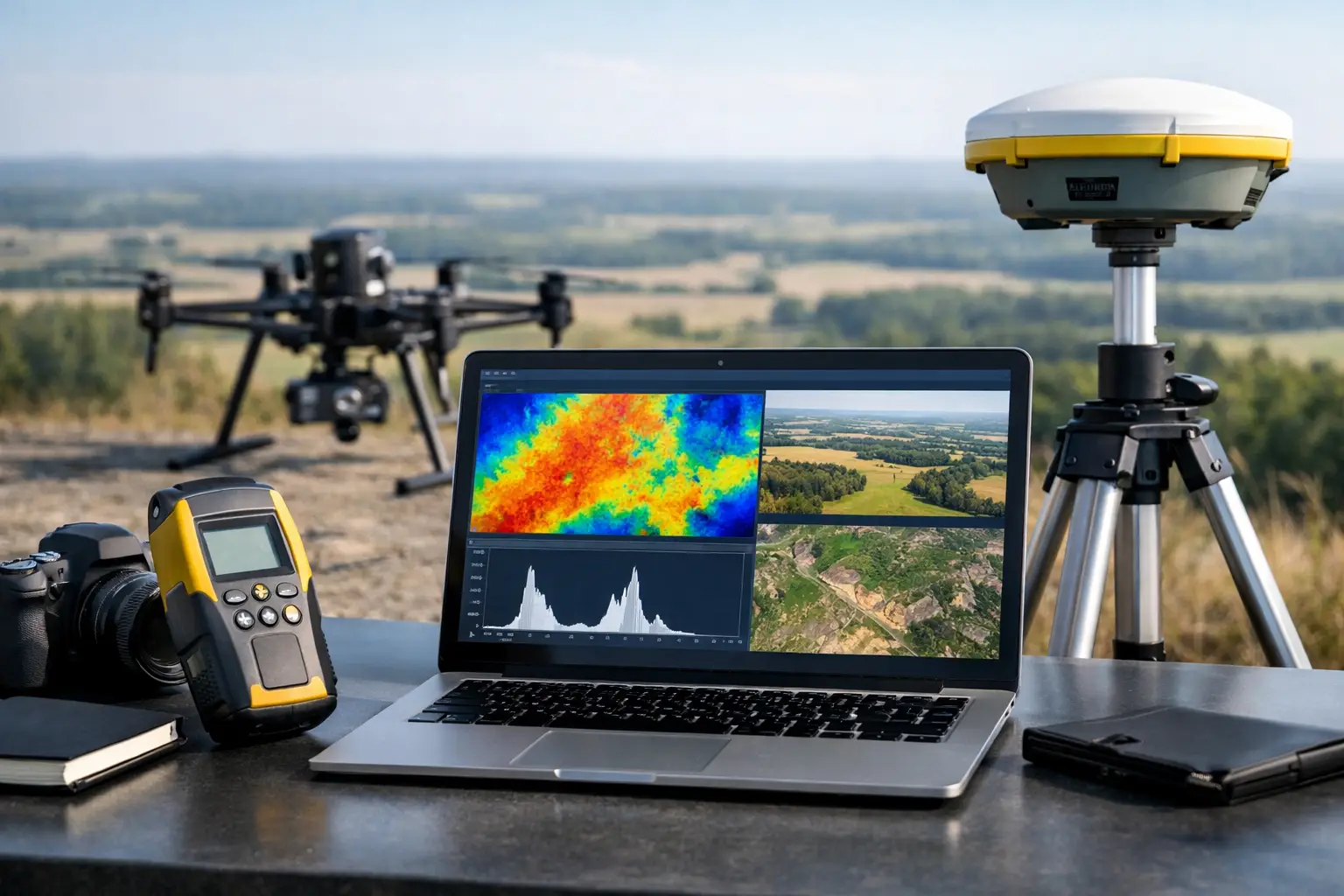
A disciplined workflow starts with sensor calibration, flight planning, and environmental controls that are appropriate to the terrain and target depth. It continues through processing, noise attenuation, positional correction, and product generation with traceable metadata. Interpretation then integrates geophysics with topography, structural mapping, existing borehole information, field observations, and hydrogeological context.
For example, a conductive corridor identified in EM data becomes more credible when it coincides with a mapped fault zone from magnetics, sits within a low-gradient recharge pathway from LiDAR, and aligns with known well productivity nearby. If one of those layers conflicts, the interpretation changes. That is not a weakness. It is the point of multi-sensor work.
This is also where enterprise buyers should be selective. Raw drone data is not the deliverable that supports procurement, engineering, or investment decisions. Interpreted, auditable geospatial intelligence is.
Where drone groundwater exploration methods fit best
These methods are especially effective in screening and prioritization. They help clients reduce uncertainty before committing to larger drilling programs, long-duration ground geophysics, or regional water infrastructure design.
In large concession areas, drones can rapidly narrow the search space and rank targets by structural favorability, conductivity pattern, recharge setting, and accessibility. In infrastructure corridors, they can support route planning by identifying shallow groundwater conditions that may affect foundations, utilities, or dewatering requirements. In mining districts, they can inform both water supply exploration and hydrogeological risk assessment around pits, waste facilities, and processing zones.
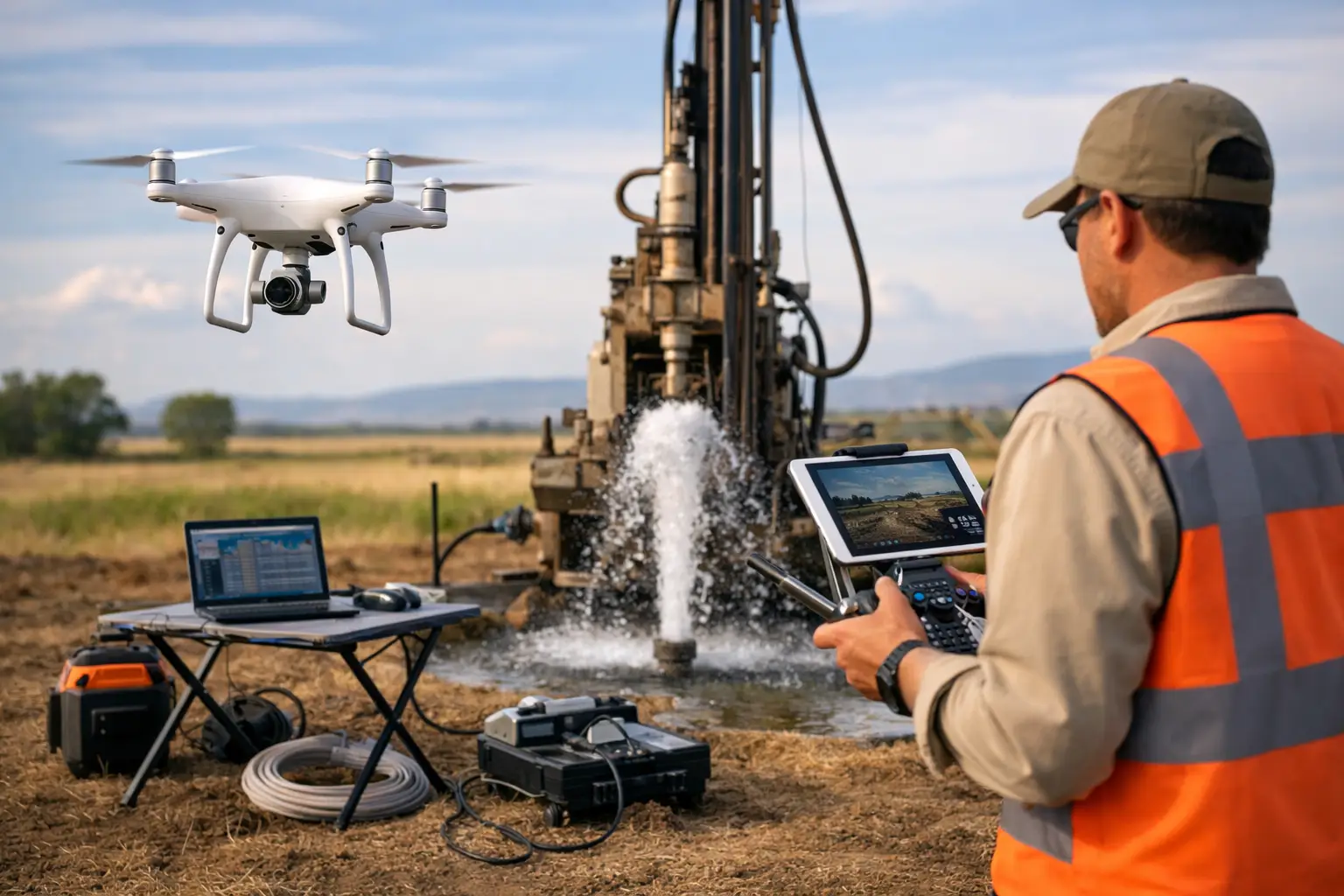
They are less likely to replace every ground method. If the project requires detailed aquifer testing, transmissivity estimates, water quality confirmation, or reservoir characterization at depth, drilling and in situ measurements remain necessary. Drone surveys are best understood as force multipliers. They improve where you drill, what you test, and how confidently you justify the next phase.
Constraints and trade-offs buyers should consider
Depth of investigation depends on the sensor, terrain conductivity, noise environment, and platform limitations. Regulatory conditions, no-fly restrictions, heat loading, and magnetic interference can all affect execution. Arid regions also create interpretation challenges because dry overburden, saline zones, and lithological contrasts may produce responses that require careful inversion and local calibration.
There is also a scale question. For broad basin screening, drones can outperform ground methods on speed and density, but they may still need to be complemented by fixed-wing or helicopter data if the area becomes very large or the target depth increases beyond practical drone system limits. For compact, high-priority blocks, drones are often the more flexible and cost-efficient option.
That is why method selection should follow project economics, geology, and decision timing, not marketing preference. The right survey is the one that reduces uncertainty at the specific stage you are in.
What a strong technical deliverable should look like
If a contractor presents attractive maps without documented processing logic, interpretation confidence should be low. A credible output package for groundwater targeting should include survey specifications, calibration records, processing notes, positional controls, QA/QC checks, interpretive assumptions, and target ranking logic. It should also distinguish clearly between measured response and inferred hydrogeological meaning.
For enterprise and government clients, auditability matters as much as resolution. Technical teams need to defend site selection, drilling budgets, and development sequencing to internal boards, consultants, regulators, and funding stakeholders. The best drone groundwater exploration methods are therefore not just fast. They are traceable, repeatable, and framed for decision use.
That is the standard high-consequence projects require, particularly across water-stressed and infrastructure-intensive regions where every field season and every borehole has a cost.
As pressure grows on water security, mining expansion, and regional development planning, the strongest survey programs will be the ones that combine speed with interpretation discipline. Drone systems have changed the economics of airborne acquisition. The real advantage comes when that data is converted into a calibrated groundwater model that tells you where to act next, and where not to.