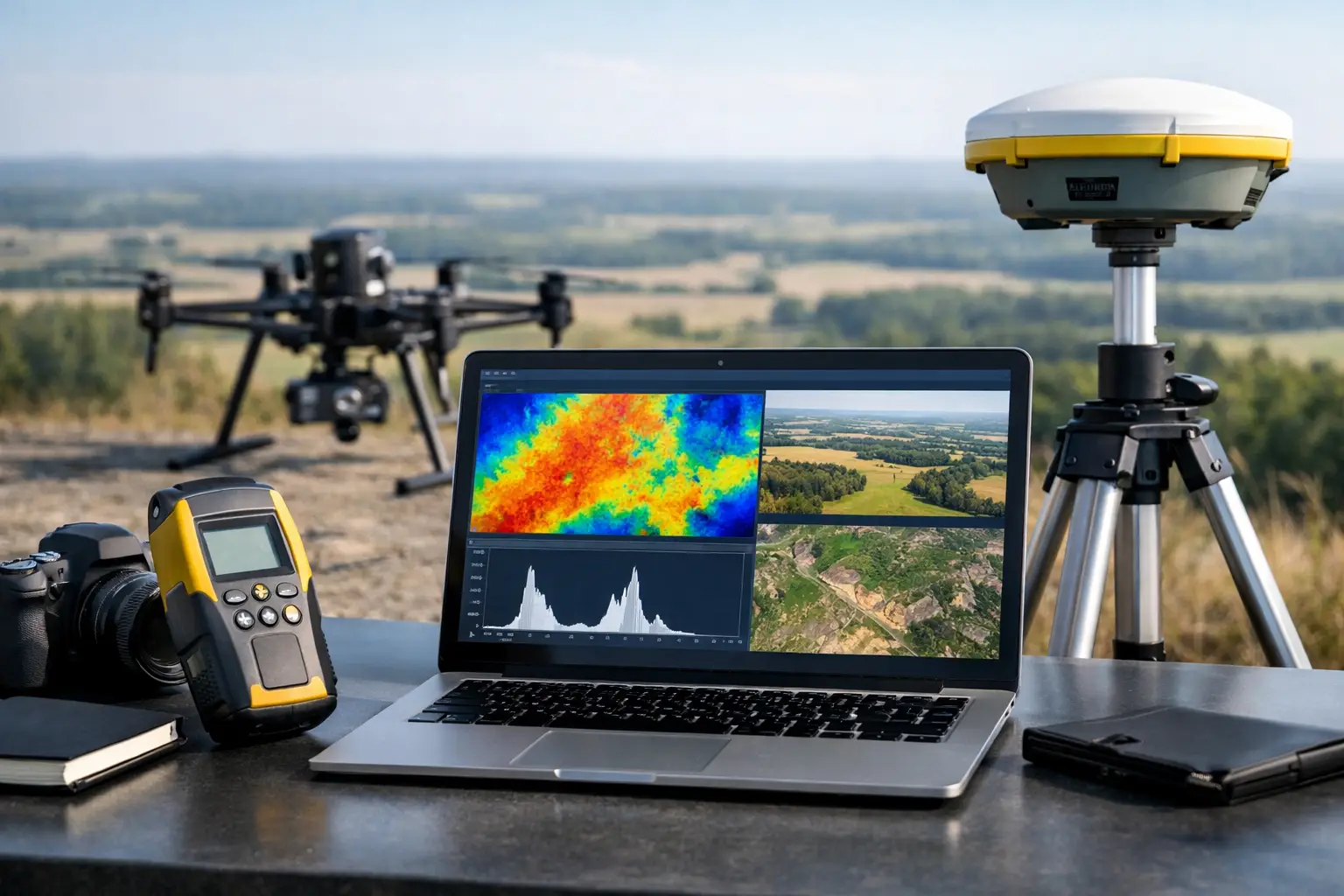
A corridor survey can look complete on paper and still miss the feature that drives cost, risk, or delay. A LiDAR surface may define terrain precisely but say nothing about shallow conductivity. Magnetic data may highlight structural trends yet fail to resolve surface obstructions, access constraints, or asset encroachment. Multi sensor data fusion mapping addresses that gap by integrating complementary datasets into a single, traceable interpretation framework.
For technical buyers, the value is not the number of sensors flown. It is whether the combined output reduces uncertainty in a way that stands up to engineering review, procurement scrutiny, and field validation. When fusion is done correctly, it shortens the path from survey mobilization to decision-grade intelligence. When done poorly, it simply layers mismatched datasets and creates false confidence.
What multi sensor data fusion mapping actually means
Multi sensor data fusion mapping is the calibrated integration of different sensing modalities so each dataset contributes what it measures best. In airborne and drone-based operations, that usually means combining some mix of LiDAR, photogrammetry, aeromagnetics, electromagnetic data, radiometrics, hyperspectral imagery, and ground control. The objective is not visual complexity. The objective is a more reliable spatial model of terrain, infrastructure, geology, utilities, water pathways, or environmental condition.
Each sensor observes a different physical property. LiDAR measures geometry. Photogrammetry contributes high-resolution visual context and surface reconstruction. Magnetics responds to variations in the magnetic field linked to geology, buried ferrous features, and structural patterns. Electromagnetic methods help characterize conductivity and can support groundwater, utility, and subsurface investigations. Hyperspectral data detects spectral signatures associated with minerals, vegetation stress, contamination indicators, or surface alteration.
No single sensor resolves every question. Fusion works because industrial projects rarely depend on one question.
Why single-sensor mapping often falls short
In high-value programs, the problem is rarely a lack of data. The problem is decision risk caused by partial visibility. An exploration manager may need to correlate lineament mapping, alteration signatures, and magnetic anomalies before allocating trenching or drilling. A utility planner may need to understand terrain, corridor congestion, and likely buried service conflicts in the same decision cycle. A water resources team may need topography, drainage behavior, and conductivity trends to prioritize recharge targets or groundwater investigation zones.
A single sensor can still be the correct commercial choice in a tightly defined scope. If the task is stockpile volumetrics, LiDAR or photogrammetry may be sufficient. If the objective is a focused magnetic reconnaissance campaign, adding extra sensors may not improve the decision. The point is narrower than many marketing claims suggest. Fusion is not automatically better. It is better when the project depends on multiple physical variables and when those variables can be integrated in a controlled, auditable workflow.
How fused mapping becomes decision-grade
The quality of fused output depends less on software branding and more on acquisition discipline. Sensor synchronization, positional accuracy, flight planning, calibration, environmental compensation, and datum consistency determine whether datasets can be cross-validated or only displayed side by side.
A serious multi-sensor workflow starts before aircraft mobilization. Survey design has to match the target scale, expected depth of investigation, required line spacing, terrain relief, and operational constraints. In desert and infrastructure environments, this also means accounting for heat loading, dust, GNSS conditions, magnetic noise sources, electromagnetic coupling, and corridor access limitations.
Once acquisition begins, every dataset needs a defined QA/QC path. That includes calibration checks, base station controls where applicable, time alignment, boresight correction, noise filtering, strip adjustment, and verification against known control or reference features. If one sensor is underperforming, the fusion output will not hide that weakness. It will propagate it.
Interpretation is where the commercial value is created. Raw layers do not produce decisions. Fused mapping becomes useful when technical teams convert sensor outputs into aligned products such as terrain-constrained anomaly maps, structurally informed target zones, utility risk surfaces, drainage and conductivity overlays, or asset corridor models with confidence classifications.
Multi sensor data fusion mapping in industrial use cases
Mining and mineral exploration
In exploration, multi sensor data fusion mapping is often used to tighten target definition before costly ground campaigns. Magnetic data can indicate structural controls and lithologic variation. Hyperspectral data can highlight surface mineral alteration. LiDAR and imagery establish access, slope, lineament expression, and terrain constraints. When integrated properly, these layers help rank targets by geological relevance and operational practicality rather than by anomaly magnitude alone.
This matters in brownfield and greenfield settings for different reasons. In brownfield environments, fusion can clarify extensions, offsets, and structurally controlled zones near known mineralization. In greenfield terrains, it helps reduce the search area and improves the logic behind staged exploration spend.
Water resources and groundwater programs
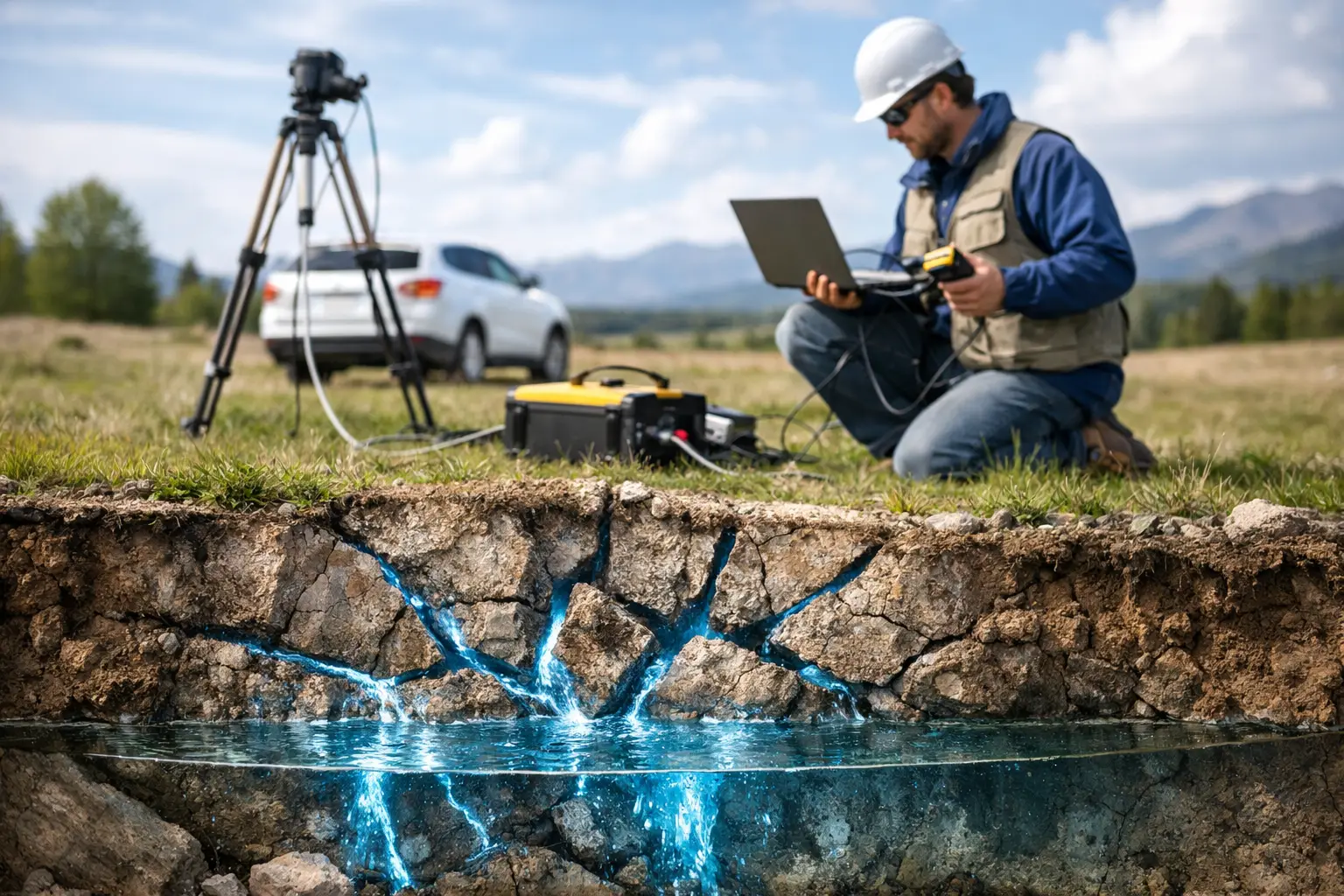
Groundwater investigations benefit from combining topographic control, drainage interpretation, conductivity response, and sometimes structural mapping. Surface form influences recharge and runoff. Conductivity data may indicate moisture pathways, salinity patterns, or subsurface contrasts that warrant follow-up. Magnetic or structural interpretation may help identify faulting or fracture-related controls.
The trade-off is that airborne indicators are indirect. Fusion improves targeting, but it does not replace hydrogeological validation. For public-sector water planning, that distinction matters. The strongest workflows use airborne fusion to prioritize field verification, not to bypass it.
Utilities, infrastructure, and corridor planning
Linear infrastructure projects are where fused mapping often delivers immediate commercial value. LiDAR defines terrain and existing assets. Imagery supports condition review and corridor context. Electromagnetic or magnetic methods may assist with utility detection or ground condition characterization in selected scenarios. The result is a more complete basis for route optimization, clash reduction, and pre-construction planning.
For EPC teams and infrastructure authorities, the practical advantage is fewer late-stage surprises. That does not mean zero surprises. Urban noise, right-of-way limitations, and buried non-metallic assets still create uncertainty. But a calibrated fusion workflow can reduce redesign cycles and improve the defensibility of early engineering assumptions.
The operational requirements clients should ask about
Not all fusion offerings are technically equivalent. Some providers are combining exported layers from unrelated workflows. Others are building integrated acquisition and processing pipelines with synchronized navigation, documented calibration, and interpretation controls. The difference affects procurement outcomes.
Buyers should focus on traceability. Ask how positional consistency is maintained across sensors. Ask how QA/QC exceptions are documented. Ask what interpretation steps are automated and what is reviewed by specialists. Ask whether outputs include confidence limits, anomaly classification logic, and metadata sufficient for audit or regulatory review.
It is also worth asking what the final deliverable is meant to support. A board-level investment gate, a drilling campaign, an environmental baseline, and a utility relocation package require different reporting standards. Fusion only adds value when the output is structured around the decision it is supposed to inform.
Why drone-based fusion changes project economics
Drone deployment does not make the physics easier, but it can make execution faster and more targeted. For many industrial scopes, drone platforms reduce mobilization time, lower access burden, and improve coverage in hazardous or logistically constrained areas. That matters in remote concessions, desert terrain, active industrial sites, and early-phase infrastructure corridors.
The commercial case is strongest when clients need repeatable, localized intelligence rather than broad regional coverage alone. A manned-aircraft campaign may still be appropriate for very large extents or specific altitude and payload requirements. But for targeted programs where rapid mobilization, lower operational risk, and high-resolution acquisition matter, drone-based fusion is often the more efficient model. Air Solutions applies this approach in mission-critical survey environments where auditability, speed, and interpreted output matter as much as raw coverage.
Where projects still go wrong
The most common failure is treating fusion as a visualization exercise instead of a measurement problem. If data are not collected to compatible standards, attractive maps can still produce weak decisions. Another failure is overpromising subsurface certainty from indirect methods. Fusion improves probability, prioritization, and context. It does not eliminate the need for selective ground truthing.
A third issue is reporting. Enterprise and government clients do not just need maps. They need calibrated deliverables that can move into engineering, procurement, compliance, or exploration planning workflows without ambiguity. That requires controlled metadata, versioned processing steps, and interpretation that explains both findings and limitations.
The strongest multi-sensor programs are therefore conservative in one useful way. They do not pretend every anomaly is a target or every overlay is a conclusion. They define what is measured, what is inferred, and what should happen next.
For organizations managing exploration budgets, infrastructure timelines, or national development programs, that discipline is the real advantage. Better mapping matters, but better decisions under uncertainty matter more.