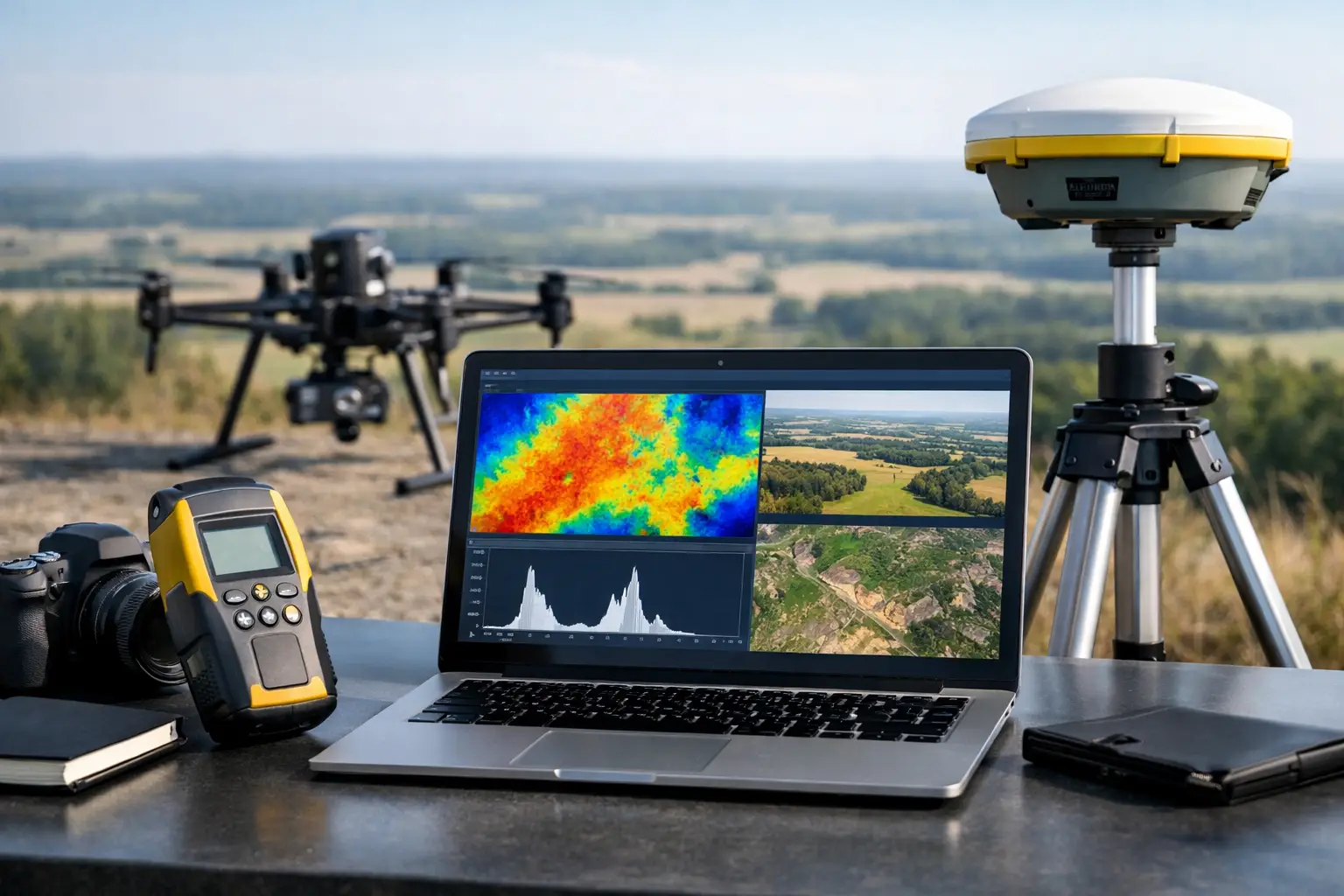
A drone survey is only as valuable as the output it puts in front of engineers, geologists, and project owners. The best drone data deliverables are not just image files or point clouds. They are calibrated, traceable, decision-ready products that shorten approval cycles, reduce field uncertainty, and stand up to technical review.
For enterprise buyers, that distinction matters. A procurement team may approve a drone campaign based on speed or safety, but the project earns its return when the final deliverables can support reserve modeling, corridor design, groundwater targeting, utility planning, or inspection decisions without requiring another costly field visit. That is why deliverable design should be treated as a core part of survey scope, not a post-processing afterthought.
What makes the best drone data deliverables
The strongest deliverables share four characteristics. They are fit for purpose, meaning the output format matches the operational decision. They are quality-controlled, with documented processing workflows, calibration steps, and positional accuracy statements. They are interpretable by the end user, not just by a remote sensing specialist. And they are auditable, so internal stakeholders, regulators, and consultants can verify how the result was generated.
This is where many drone programs underperform. A contractor may provide raw imagery, a generic map package, or an oversized dataset with no clear decision path. That creates handoff risk. Technical teams then spend time translating data into something usable, and executives are left paying for collection twice - once in the field and again in internal cleanup.
1. Orthomosaics remain one of the best drone data deliverables
For surface-level situational awareness, a high-resolution orthomosaic is still one of the most practical outputs available. It gives planners, engineers, and field teams a geometrically corrected image base that can be measured, annotated, and compared over time.
Orthomosaics are especially effective for construction progress tracking, haul road condition reviews, environmental disturbance mapping, and site logistics planning. In mining and infrastructure settings, they often become the shared visual reference used across multiple functions, from operations to HSE to design consultants.
The trade-off is straightforward. Orthomosaics are visually intuitive, but they do not replace elevation products or subsurface intelligence. If the project depends on cut-fill analysis, drainage behavior, or structural interpretation, the orthomosaic should be paired with a surface model or another sensor-derived layer.
2. Digital surface models and terrain models for engineering control
A digital surface model, and where appropriate a digital terrain model, is often the deliverable that moves a drone survey from visual documentation into engineering utility. These products support slope analysis, drainage studies, stockpile estimation, route optimization, and grading control.
For EPC contractors, developers, and public infrastructure owners, elevation products are valuable because they convert aerial collection into measurable terrain intelligence. A DSM captures buildings, vegetation, and above-ground features. A DTM aims to represent the bare earth surface. Which one is best depends on the question being asked.
On a cleared industrial site, a DSM may be sufficient for planning and volumetric work. In vegetated or geologically complex areas, a DTM derived from LiDAR or carefully filtered photogrammetric data may be required. The difference matters because design tolerances and hydrological interpretations can shift quickly when vegetation or surface clutter is not properly handled.
3. Classified point clouds for high-density spatial analysis
Point clouds are among the most technically valuable deliverables when the client has a team capable of using them. They preserve a detailed three-dimensional representation of the survey environment and can be classified into terrain, structures, vegetation, utilities, and other feature classes.
This makes them highly effective for mine planning, corridor mapping, asset modeling, and design integration. A classified point cloud is also a strong base layer for downstream CAD, BIM, and GIS workflows. For projects with multi-phase engineering or repeated monitoring, it provides a reusable spatial record rather than a one-time visual product.
The limitation is usability. Point clouds are data-rich but not always decision-ready for non-specialists. If the client organization includes mixed technical audiences, the better approach is often to deliver the point cloud alongside extracted surfaces, contours, and interpreted mapping layers. That preserves analytical depth without forcing every stakeholder into a specialist software environment.
4. Volumetric calculations and change detection reports
Many industrial buyers do not need more data. They need quantified change. That is why volumetric reports and temporal comparison deliverables rank among the best drone data deliverables for active operations.
In quarrying, mining, bulk materials handling, and earthworks, stockpile volumes and cut-fill balances directly affect cost control, reconciliation, and contractor payment. In linear infrastructure and megaproject settings, repeat surveys can show whether progress aligns with schedule, whether erosion is developing, or whether unauthorized ground disturbance has occurred.
The value here comes from method control. Volume calculations are only credible if control points, base surfaces, survey intervals, and exclusion rules are clearly documented. A one-number output with no methodology note has limited value in a claims environment or technical audit. A fully traceable report, by contrast, can support finance, operations, and dispute resolution at the same time.
5. Interpreted geophysical maps for subsurface decision-making
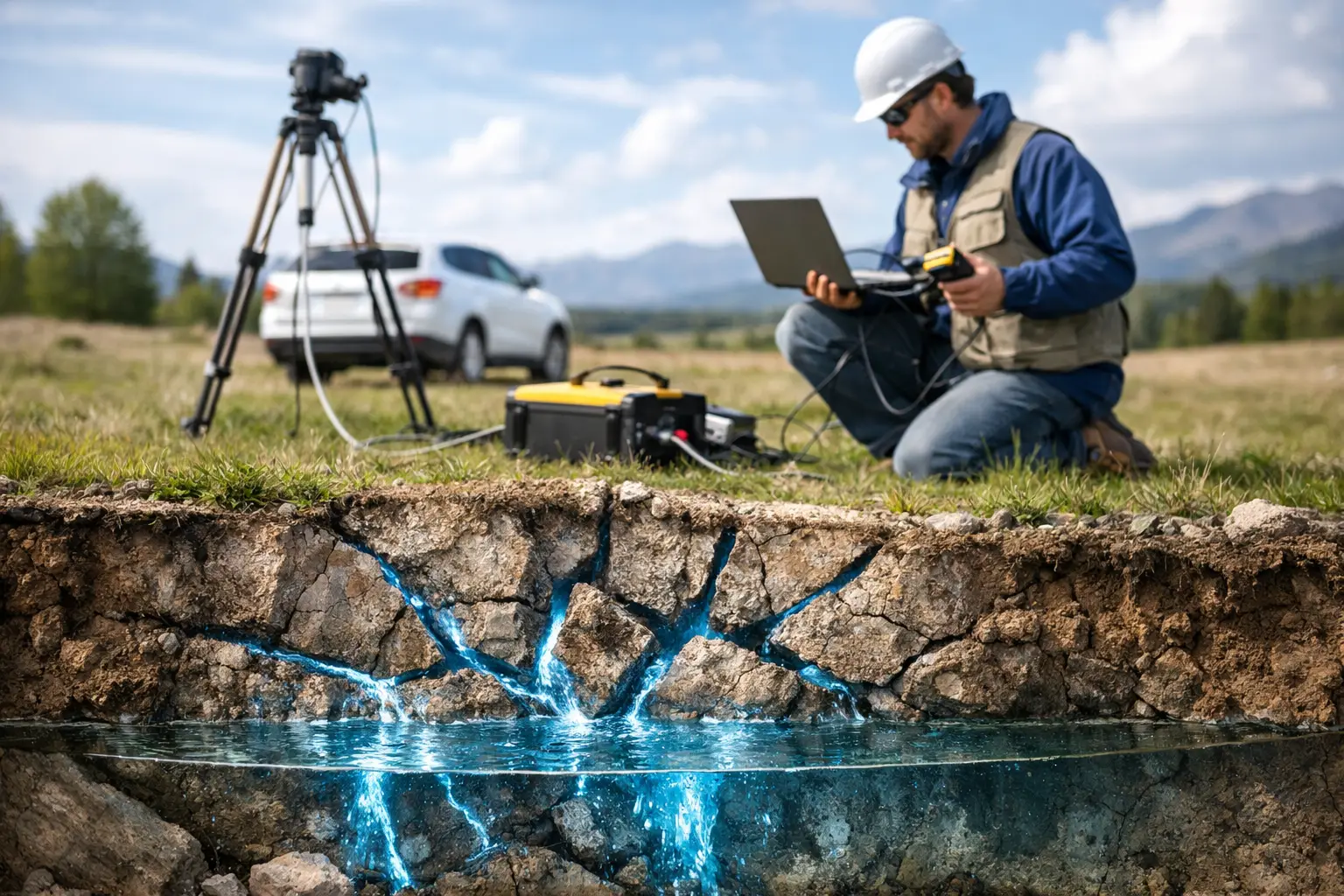
For exploration, groundwater, and utility detection work, interpreted geophysical deliverables often carry more value than any surface map. Magnetic intensity maps, electromagnetic conductivity sections, radiometric layers, and inversion-based subsurface models turn airborne acquisition into operational targeting.
This is where the distinction between data collection and geospatial intelligence becomes critical. Raw magnetic or electromagnetic files are rarely the endpoint for a resource company or public agency. They need leveled, corrected, georeferenced outputs with interpretation tied to structural trends, lithological variation, alteration signatures, salinity behavior, or buried infrastructure anomalies.
These deliverables are most useful when paired with acquisition parameters, processing logs, interpretation notes, and confidence statements. A technically strong client will ask how diurnal correction was handled, how line leveling was performed, how anomalies were ranked, and how interpretations were cross-validated against existing geology or ground truth. The deliverable should answer those questions before they are asked.
6. LiDAR and photogrammetry feature extraction packages
Not every client wants a full sensor archive. Often, the most commercially useful output is a feature extraction package built from LiDAR or photogrammetry. This may include contours, breaklines, building footprints, utility poles, road edges, drainage channels, berms, fence lines, or other mapped assets ready for engineering use.
These deliverables reduce friction between survey completion and project execution. Instead of assigning internal teams to digitize or interpret raw data, the contractor provides structured outputs aligned to the client's design environment and asset taxonomy.
This is particularly important in utility, transport, and civil development programs where multiple consultants and contractors need a common spatial baseline. If extraction standards are not agreed in advance, however, rework becomes likely. A technically mature scope should define feature classes, tolerances, coding structure, coordinate reference requirements, and acceptance criteria before mobilization.
7. QA/QC-backed technical reports and decision memos
The final deliverable is often the one that decides whether a dataset gets used or shelved. A disciplined technical report - supported by QA/QC records, processing lineage, accuracy metrics, and interpretation context - converts drone outputs into something procurement, engineering, and executive teams can approve with confidence.
This matters most in regulated, capital-intensive, or multi-stakeholder environments. A map may look convincing, but decision-makers need to know sensor configuration, survey extent, control methodology, weather constraints, processing assumptions, and residual limitations. Without that context, the dataset can become difficult to defend during design review, funding approval, or regulatory submission.
Air Solutions operates in exactly this part of the market, where audit-traceable reporting and interpreted outputs are not optional extras but part of the contract value. For high-consequence projects, the report is not paperwork. It is the bridge between airborne sensing and an accountable business decision.
Choosing the best drone data deliverables for your project
The right package depends on the risk profile of the decision. If the goal is site communication and basic mapping, orthomosaics and surface models may be enough. If the goal is engineering design, feature extraction, classified point clouds, and controlled elevation products become more important. If the goal is subsurface targeting or utility risk reduction, interpreted geophysical deliverables should take priority.
Procurement teams should also ask a simple question early: who will use the output on day one? A GIS analyst, a mine geologist, a civil designer, and a ministry reviewer all need different forms of evidence. The best scope is usually a layered one, where raw and processed datasets are preserved, but the primary deliverables are tailored to the operational decision and the review environment.
A drone can mobilize quickly, fly safely, and collect dense data in difficult terrain. None of that matters if the final handover does not answer the project's real question. The best deliverables are the ones that reduce uncertainty fast enough to keep a decision moving.