A grading plan that looks clean in the office can fail quickly in the field if the terrain model is wrong by even a small margin. On large construction sites, that gap between assumed conditions and actual conditions drives rework, schedule drift, quantity disputes, and avoidable safety exposure. Photogrammetry for construction planning addresses that problem by converting overlapping aerial imagery into measurable, decision-grade surface data before crews, plant, and procurement commitments are fully locked in.
For planners, EPC teams, and project owners, the value is not the imagery itself. The value is a calibrated representation of site reality that can be traced, checked, and used across design coordination, earthworks planning, access analysis, and progress verification. When deployed correctly, photogrammetry reduces uncertainty at the stage where uncertainty is still cheap to fix.
What photogrammetry for construction planning actually delivers
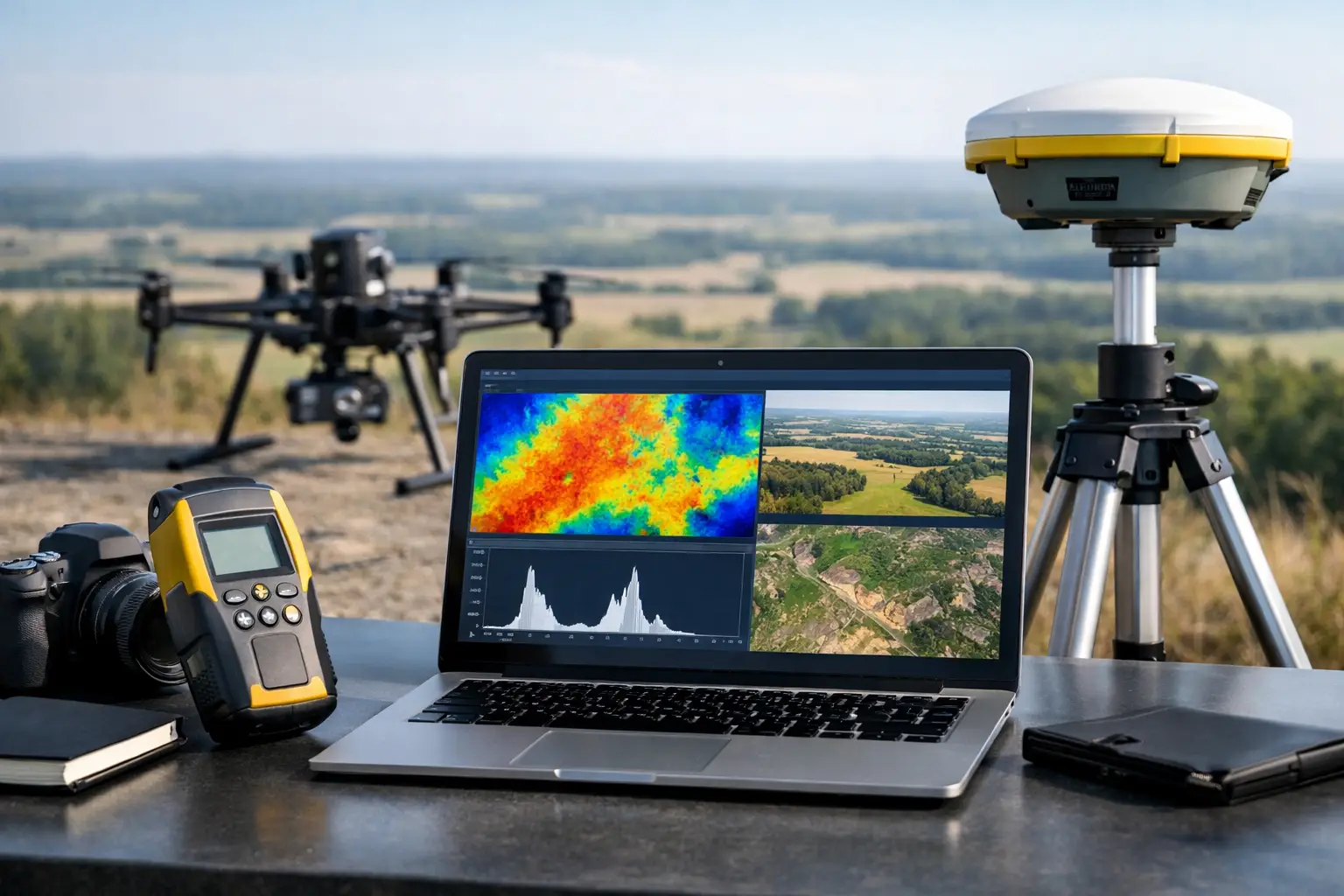
Photogrammetry reconstructs three-dimensional site conditions from high-overlap images captured by drone or aircraft. The processing workflow identifies common points across multiple images, solves camera positions, and generates outputs such as orthomosaics, dense point clouds, digital surface models, contours, cut-and-fill estimates, and textured 3D meshes.
In construction planning, those outputs become working inputs for engineering and commercial decisions. Teams use them to validate existing topography, assess drainage pathways, define haul routes, estimate stockpile volumes, identify obstructions, and establish a reliable baseline before excavation or structural work begins.
The distinction that matters is between visually impressive data and decision-grade data. A photogrammetry product is useful only if control, calibration, processing parameters, and QA/QC are managed properly. Without those controls, a model may look correct while introducing errors that compound through design revisions and field execution.
Where it creates the most value in planning
The strongest use case for photogrammetry for construction planning is early-stage site intelligence. Before permanent works begin, project teams need a current, measurable view of terrain, access constraints, drainage behavior, boundary conditions, and interactions with nearby assets. Conventional survey remains essential in many contexts, but it can be slow to scale across large or fast-changing sites.
Drone-based photogrammetry closes that gap. A single mobilization can capture broad areas quickly, including disturbed ground, temporary works, laydown areas, borrow pits, utility corridors, and access roads. For infrastructure and industrial developments, this broader spatial context often matters as much as the core build footprint.
Photogrammetry is also effective during design development. If planners are working through alternative pad locations, road alignments, or staging layouts, refreshed aerial datasets provide a current terrain model rather than a stale preconstruction reference. That matters on sites where grading, dewatering, or temporary diversions are changing conditions week by week.
During execution, the same method supports progress measurement and commercial control. Earthwork advancement, stockpile movement, drainage formation, and excavation extents can be checked against planned surfaces and prior survey epochs. That creates a clearer audit trail for quantity reconciliation and contractor reporting.
Accuracy depends on methodology, not marketing
Photogrammetry has real strengths, but it is not a universal substitute for every survey requirement. Accuracy depends on flight planning, image overlap, camera calibration, lighting conditions, surface texture, control distribution, and processing discipline. If any of those elements are weak, the outputs can drift.
Ground control points and check points remain central where high positional confidence is required. They anchor the model to known coordinates and provide independent verification of final accuracy. On critical projects, the workflow should document sensor settings, flight altitude, overlap percentages, control methodology, residuals, and final error metrics. For enterprise buyers, that traceability is not optional. It is part of procurement confidence.
Surface type also affects performance. Photogrammetry performs well on textured terrain, compacted soil, aggregate, and built features with clear visual contrast. It is less reliable on reflective surfaces, uniform sand, standing water, or areas with dense vegetation that conceal the true ground. In those conditions, planners may need complementary sensing, especially LiDAR, to maintain confidence in bare-earth interpretation.
That trade-off matters in Gulf construction environments. Harsh light, heat shimmer, dust, and low-texture surfaces can all degrade image quality if operations are not timed and managed carefully. A contractor with desert-ready flight discipline and a documented processing workflow is materially different from a generic drone operator collecting pictures.
Photogrammetry and LiDAR are not interchangeable
Buyers often compare photogrammetry with LiDAR as if they serve the same function at the same performance level. In practice, they are complementary.
Photogrammetry typically provides high-resolution visual detail and strong value for topographic modeling, planning visualization, and volumetric analysis when surfaces are visible and well textured. It is often more cost-efficient for broad site mapping and frequent repeat capture.
LiDAR is generally stronger where vegetation penetration, low-texture terrain, or complex elevation extraction is a concern. It can also provide more reliable geometry in lighting conditions that challenge optical workflows. If the planning problem is primarily about visible surface conditions and rapid site updates, photogrammetry may be the right first tool. If the planning problem includes concealed ground, utility corridors with vegetation, or stringent bare-earth extraction, LiDAR may be the better primary dataset.
For complex developments, the highest-value approach is often data fusion. A photogrammetric model can provide rich visual context, while LiDAR supplies stronger elevation confidence in difficult areas. That combined approach supports planners who need both engineering accuracy and field-readable site context.
A disciplined workflow for construction planning
The operational sequence matters as much as the sensor. A reliable program usually starts with scope definition tied to planning decisions, not just map production. The team needs to define coordinate systems, expected tolerances, coverage area, deliverables, and intended downstream use in design or quantity workflows.
Capture planning follows. Flight altitude, overlap, ground sample distance, sun angle, control placement, and airspace constraints all affect final quality. On active or high-risk sites, the capture plan must also account for exclusion zones, lifting operations, traffic management, and workface coordination.
Processing should then move through a controlled chain: image QA, aerotriangulation, control adjustment, dense reconstruction, surface generation, and independent accuracy checks. Deliverables should be aligned to planning use cases, whether that means orthomosaics for coordination, terrain models for grading design, contours for drainage review, or volumetric reports for commercial control.
The final step is often overlooked. Data has to be interpreted into planning intelligence. A technically mature provider does not stop at exporting a model. It flags slope risk, drainage breaks, access limitations, encroachments, and earthwork deviations in a form planners and project managers can act on quickly.
Why enterprise buyers care about auditability
Construction planning decisions carry downstream cost. If a terrain model informs excavation depth, pad elevation, material balancing, or temporary drainage design, the dataset may later sit behind variation claims, schedule analysis, and technical reviews. That is why auditability matters.
An auditable photogrammetry workflow records how the data was captured, controlled, processed, validated, and reported. It provides checkable evidence rather than informal outputs. For government clients, EPC contractors, and national infrastructure programs, that level of rigor supports internal assurance, consultant review, and cross-party alignment.
This is where specialist operators stand apart. Air Solutions, for example, positions drone-acquired geospatial data as interpreted, QA/QC-governed intelligence rather than raw imagery delivery. That model is better aligned with construction planning because project teams need defensible answers, not just files.
Common failure points to avoid
Most problems with photogrammetry in construction are not caused by the core technology. They come from poor operational discipline.
The first failure point is using outdated site capture. On dynamic projects, even a few weeks can make a terrain model unsuitable for active planning. The second is insufficient control and no independent validation. The third is assuming the model represents bare earth when vegetation, equipment, stockpiles, or temporary works are embedded in the surface.
Another common issue is forcing photogrammetry into applications that exceed its practical fit. If the site includes reflective roofs, water bodies, featureless sand, or dense cover, planners should ask whether another sensing method or a combined workflow is required. Good geospatial planning is not about defending one tool. It is about selecting the right method for the decision at hand.
What to ask before commissioning a survey
Before procuring photogrammetry for construction planning, buyers should ask how accuracy will be controlled, what independent checks will be performed, how current the site model will be at delivery, and whether the outputs are optimized for design software and quantity workflows. They should also ask how the provider manages difficult conditions such as dust, heat, low-texture terrain, and active site constraints.
Those questions quickly separate image capture vendors from geospatial contractors. The difference is visible later, when planners need confidence in grades, volumes, and site constraints under real commercial pressure.
Construction planning improves when uncertainty is measured early and updated often. Photogrammetry is effective because it turns changing site conditions into a working spatial record that engineers, planners, and commercial teams can actually use - provided the workflow is controlled to the same standard as the decisions it supports.