A drilling program can absorb millions before a team knows whether alteration continuity, lithologic boundaries, and mineral vectors were interpreted correctly. That is why hyperspectral imaging for mineral exploration has moved from a specialist research tool to a decision-grade survey method. When deployed with calibrated sensors, controlled workflows, and geologic interpretation, it gives exploration teams a faster way to map mineralogy, rank targets, and reduce uncertainty before committing heavier capital.
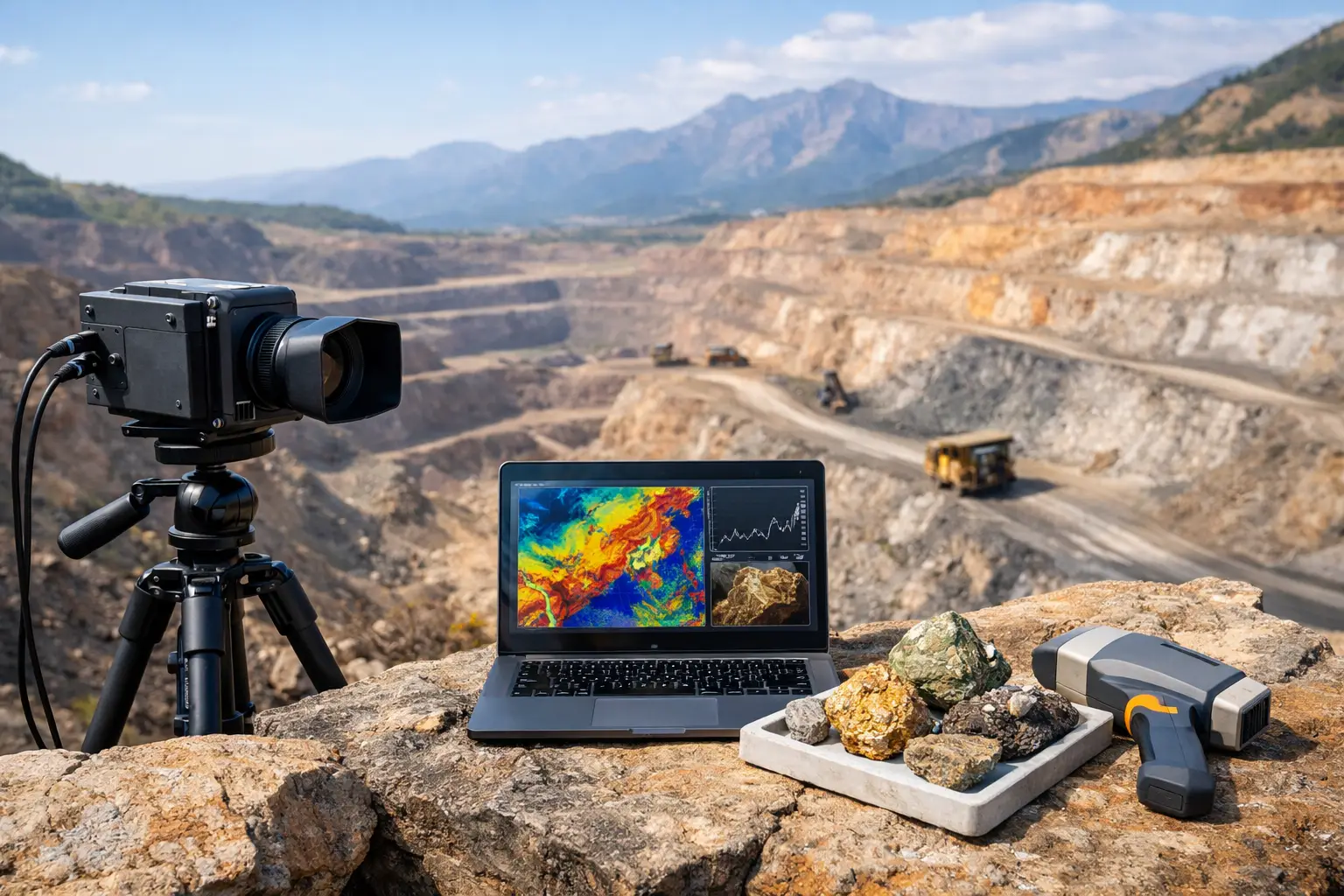
The value is not simply better pictures. Hyperspectral systems measure reflectance across dozens to hundreds of narrow spectral bands, allowing geologists to distinguish materials that appear similar in standard RGB or even multispectral imagery. In mineral exploration, that matters most where alteration minerals carry the geochemical footprint of a system. Clay assemblages, iron oxides, carbonates, sulfates, and silica-related signatures can all indicate fluid pathways, weathering patterns, and zones of hydrothermal activity. The practical result is sharper target definition, especially in large license areas where field mapping alone is too slow and sparse.
What hyperspectral imaging detects in mineral exploration
Most exploration teams are not buying spectral data for its own sake. They want to know whether the system can separate mineral classes that matter to an economic model. Hyperspectral imaging is most effective when the target minerals or alteration halos have diagnostic absorption features within the sensor's range, commonly in the visible-near infrared and short-wave infrared regions.
This is where the method earns its place. Al-OH, Mg-OH, Fe-bearing minerals, carbonates, and hydrated phases often produce recognizable spectral responses. Those responses can support mapping of sericite, kaolinite, chlorite, epidote, hematite, goethite, calcite, dolomite, and related alteration indicators. For porphyry, epithermal, IOCG, and some sediment-hosted systems, that information can materially improve vectoring toward mineralization.
The trade-off is straightforward. Hyperspectral imaging does not directly detect every ore mineral, and it is not a substitute for drilling, geochemistry, or geophysics. Sulfides at depth, for example, may have little direct surface expression or may be obscured by transported cover, weathering, or surface contamination. The method is strongest when used to map surface or near-surface mineralogy and then fused with structural interpretation, magnetic data, radiometrics, electromagnetic response, and field validation.
Why hyperspectral imaging for mineral exploration works best as part of a system
Used in isolation, hyperspectral data can identify mineralogical patterns. Used within a disciplined exploration framework, it can change the economics of a program. The difference lies in integration.
A mineral map becomes more valuable when it is co-registered against topography, drainage, lineaments, magnetic trends, and known sample points. Alteration anomalies that look compelling in spectral space may weaken when checked against structure or geomorphology. Others that appear subtle may strengthen when aligned with faults, intrusive contacts, or conductive zones. For that reason, the strongest operational model is multi-sensor fusion rather than single-sensor acquisition.
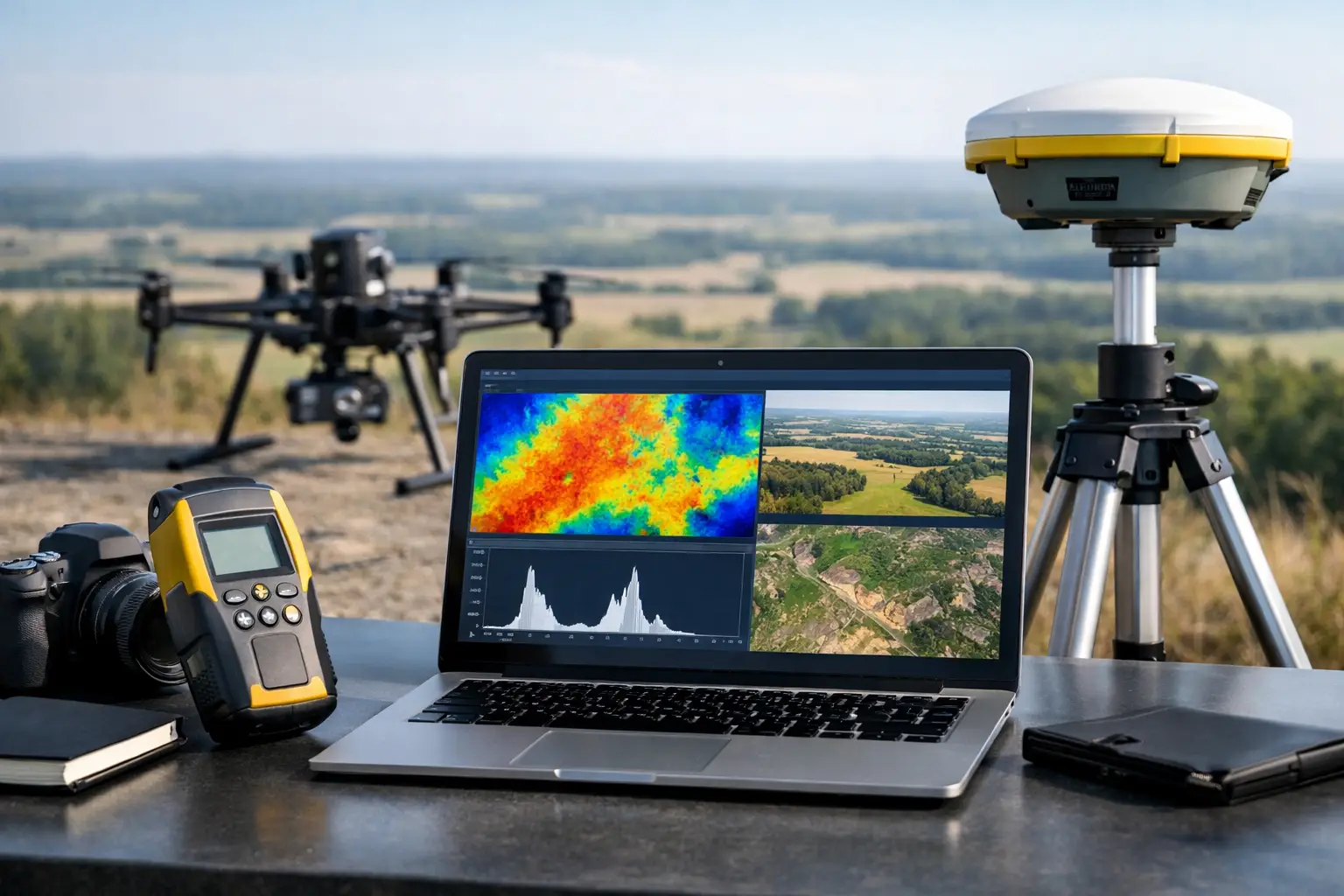
This is also where drone-based deployment has a measurable advantage. Fixed, low-altitude acquisition improves ground sampling distance and allows tighter control over mission geometry. For difficult terrain, remote concessions, and harsh desert environments, rapid mobilization reduces the time between target selection and interpreted output. That is commercially significant for exploration managers trying to keep programs moving without waiting on manned aircraft scheduling or broad regional datasets that lack the needed resolution.
The operational workflow that determines data quality
In hyperspectral work, sensor performance is only one part of the result. The real determinant is whether the acquisition and processing chain is auditable.
Survey design starts with altitude, spectral range, sun angle, and expected target size. If the objective is broad alteration zonation, the mission may prioritize area coverage. If the objective is outcrop-scale mapping along structurally controlled corridors, the design should prioritize spatial resolution and flight repeatability. Those are different jobs and should not be treated as interchangeable.
Field calibration is equally critical. Illumination conditions, atmospheric effects, detector noise, and platform motion all influence the raw signal. Without reference panels, radiometric correction, geometric correction, and spectral normalization, a mineral classification can drift from defensible interpretation into colored imagery with weak analytical value. Serious programs require traceable calibration records, repeatable preprocessing, and QA/QC checkpoints that can survive technical scrutiny.
Interpretation then moves from spectra to geology. That stage should include endmember selection, mineral classification, confidence screening, and cross-validation against field observations, laboratory spectroscopy, or sampled reference points. Automated classification is useful, but unsupervised outputs are not enough for investment decisions. An exploration team needs interpreted products that explain why a zone is prospective, how confident the classification is, and where additional work should be focused.
Where hyperspectral imaging adds the most value
The highest return typically comes early enough to influence program design, but late enough that there is already a working geologic hypothesis.
Regional greenfield screening is one use case, particularly where large concession blocks need to be narrowed into ranked corridors. Here, hyperspectral imaging can rapidly identify mineralogical domains, alteration trends, and surface expressions that justify closer follow-up. In brownfield settings, the method often supports extensions around known deposits by clarifying alteration footprints beyond mapped areas.
It is also effective in structurally complex or logistically constrained terrain. In those settings, field teams may only access a fraction of the area with equal observation density. Aerial spectral mapping creates continuity between sparse field stations, helping geologists see whether isolated outcrops belong to the same system or different alteration events.
For arid regions, the case is particularly strong. Limited vegetation cover improves spectral visibility, and wide exposed surfaces can produce high-value mineralogical mapping at scale. That does not remove the need for validation, but it improves the signal environment compared with heavily vegetated districts where canopy masks the target geology.
Limits, false positives, and the questions procurement teams should ask
The method has constraints, and sophisticated buyers should expect them to be stated clearly.
Surface cover is the first issue. Sand, alluvium, varnish, dust, and anthropogenic disturbance can mute or distort spectral signatures. Weathering can either help by exposing alteration minerals or mislead by overprinting the primary system. Illumination changes and terrain shadow introduce additional complexity, especially in rugged topography. If those factors are not accounted for, confidence drops fast.
The second issue is overclaiming resolution. A hyperspectral sensor may detect diagnostic bands, but that does not mean every mineral can be cleanly separated under field conditions. Spectral mixing is common, particularly where pixels contain combinations of rock, soil, and weathered fragments. Interpretation must therefore express uncertainty honestly and distinguish probable classifications from confirmed mineral assemblages.
For procurement and technical evaluation, the right questions are operational. Was the sensor calibrated before and during deployment? What atmospheric and radiometric corrections were applied? How were classifications cross-validated? What spatial accuracy was achieved? How are confidence levels reported? Can the contractor deliver interpreted geoscience products rather than raw cubes alone?
These questions matter because exploration budgets are not spent on data collection. They are spent on decision support.
Why drone deployment changes the business case
For many projects, the shift from conventional airborne surveying to drone-based hyperspectral acquisition is less about novelty and more about control. Lower operating altitudes, flexible mobilization, and targeted coverage reduce wasted acquisition. Teams can survey priority corridors, revisit anomalies quickly, and integrate new field observations without waiting through long scheduling cycles.
That speed has strategic value in active programs. If an exploration manager receives calibrated, interpreted outputs early enough to redirect mapping crews, adjust trenching, or refine drill collar planning, the survey has already paid for part of itself. If the data arrives as an isolated technical deliverable with weak geological context, much of that value is lost.
This is why specialist operators such as Air Solutions position hyperspectral work as one component of a broader geospatial intelligence stack. The commercial advantage is not only airborne access. It is the ability to fuse spectral, topographic, magnetic, radiometric, and site-specific data into a reporting framework that is technically defensible and operationally useful.
The most effective use of hyperspectral imaging for mineral exploration is not to replace established methods. It is to compress the distance between early-stage uncertainty and a better-informed next move. For teams working under capital pressure, terrain constraints, or compressed development timelines, that is often the difference between collecting data and making progress.