
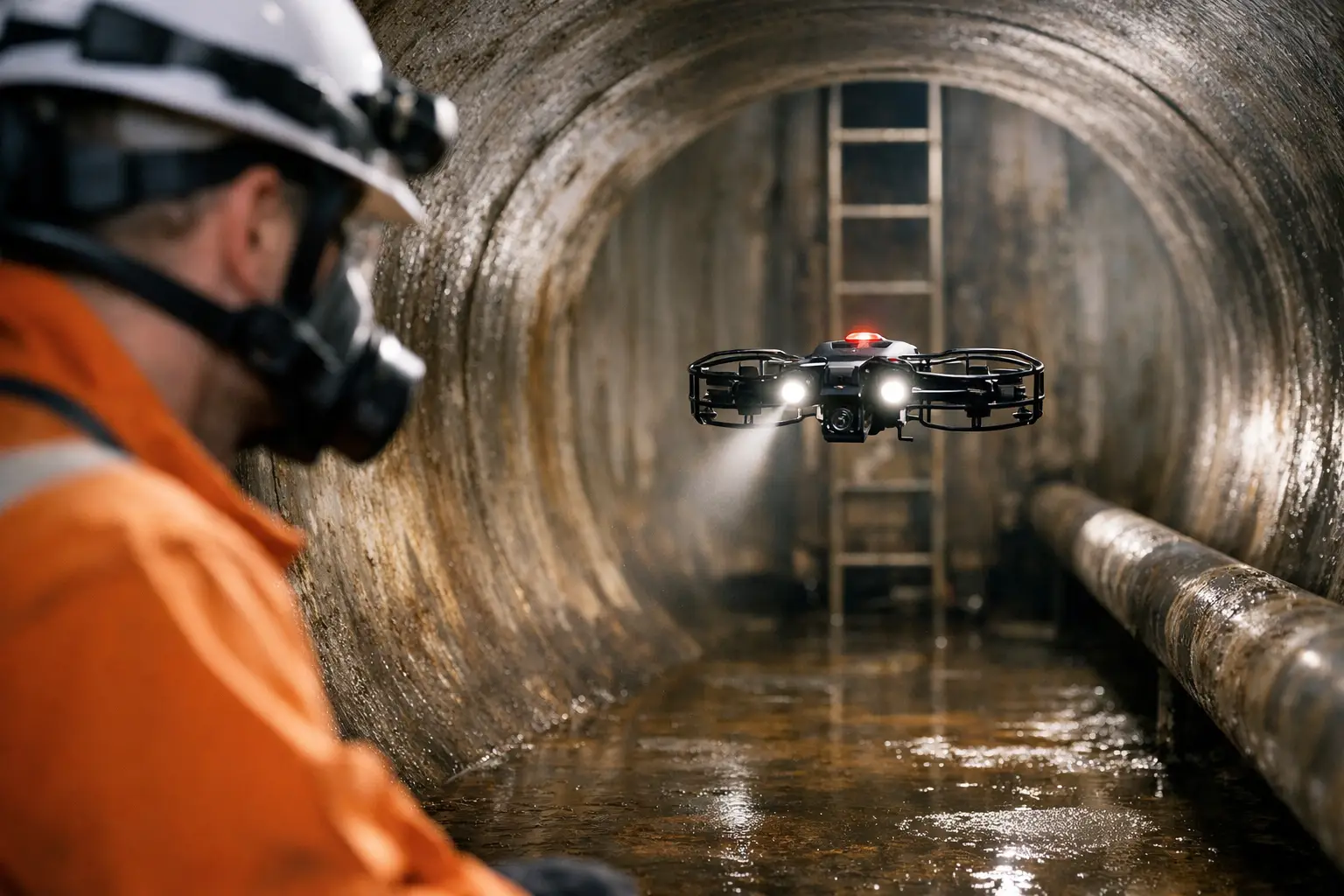
A shutdown window can cost more than the inspection itself. That is why confined space drone inspection has moved from a specialist option to a practical requirement across power, mining, oil and gas, water, and heavy industry. When the asset is a tank, vessel, boiler, stack, tunnel, or underground void, the decision is no longer just about getting eyes inside. It is about getting defensible data without exposing personnel to avoidable risk or extending outage duration.
Traditional confined-space entry still has a place in maintenance programs, but it carries obvious constraints. Permitting is intensive. Atmospheric testing, rescue planning, scaffolding, rope access, and production isolation all add time and cost. In many cases, the first objective is simply to understand whether human entry is even necessary. A drone can answer that question quickly, and in many scenarios it can complete the primary visual inspection without sending anyone inside.
Where confined space drone inspection delivers the most value
The strongest use cases are assets with difficult access, poor visibility, unstable geometry, or contamination risk. That includes storage tanks, pressure vessels, flare stacks, ducts, culverts, penstocks, furnaces, silos, and sewers. It also includes stopes, shafts, and ore passes in mining, where void mapping and condition assessment may need to happen under active operational constraints.
The value is not limited to safety. It is also operational. If a drone can be deployed after isolation and gas testing, inspection teams can collect actionable imagery in a fraction of the time required for scaffolded access. That shortens the decision cycle for maintenance planners, integrity engineers, and shutdown managers. In enterprise environments, time saved on one asset matters, but time saved across a portfolio matters more.
A disciplined program also improves inspection consistency. Visual findings can be recorded, timestamped, georeferenced where appropriate, and archived as a traceable baseline for later comparison. That matters when clients need evidence for compliance, maintenance prioritization, or contractor validation.
Why confined space drone inspection is not just a safer camera
There is a tendency to frame these systems as flying cameras. That understates the technical shift. A capable confined-space platform is a stabilized sensing tool designed for degraded GNSS conditions, low light, dust, and collision-prone geometry. It must hold position without satellite navigation, tolerate intermittent airflow, and recover from contact events without losing control.
Sensor selection is equally important. High-lumen lighting is not optional in blacked-out interiors. Low-light imaging, obstacle awareness, and protected airframes all affect mission reliability. In some environments, the highest-value output is not cinematic video. It is a calibrated, reviewable visual record tied to a structured asset register and defect coding framework.
That distinction matters for procurement teams. Buying a drone flight is not the same as procuring inspection-grade data. The deliverable should align with the maintenance question being asked. Are you screening for corrosion, cracking, refractory loss, weld condition, blockage, deformation, or water ingress? Are you validating an anomaly found by another method? Are you deciding whether to escalate to manned entry, NDT, or repair? The inspection workflow should be built backward from that decision point.
The operational trade-offs decision-makers should understand
Confined space drone inspection is highly effective, but it is not universal. Visual inspection has limits. If a client requires wall thickness measurement, material sampling, or contact-based NDT, a drone will not replace those methods. It can, however, reduce the scope of intrusive work by identifying where direct testing is actually needed.
Environment also matters. Dense dust, steam, liquid mist, or reflective interiors can degrade image quality and flight stability. Magnetic interference, narrow constrictions, and turbulent airflow from active ventilation can complicate navigation. Battery life is another planning factor, especially in large assets where multiple entries may be needed to cover vertical sections and side chambers.
This is where disciplined mission design separates useful deployment from novelty. The operator needs to define flight path logic, lighting requirements, contingency procedures, image capture intervals, and criteria for reflight. A fast inspection that misses the defect zone is not efficient. The objective is controlled coverage with enough fidelity to support engineering decisions.
A typical inspection workflow
In industrial settings, the work starts well before takeoff. Site teams confirm asset status, isolation conditions, permit requirements, and atmospheric readings. The inspection provider reviews geometry, entry points, known hazards, and client reporting requirements. If previous inspection data exists, it should be used to define target areas and comparative views.
Once on site, the drone system is configured for the asset class and lighting condition. The pilot conducts a short validation flight near the entry point, then progresses through a planned route that balances coverage, standoff distance, and signal confidence. In large or complex interiors, the mission may be segmented by chamber, elevation, or structural zone.
Data review should happen immediately after capture, not days later. Field-level QA/QC allows the team to identify blind spots, insufficient illumination, or incomplete sections while the asset is still available. That is a major advantage during outages, where remobilization can be expensive or impossible.
Post-processing is where inspection value becomes decision-grade. Raw video alone is rarely enough for enterprise clients. What matters is a structured output package: annotated imagery, defect logs, asset-location references, observation severity, and a clear statement of inspection limits. For clients managing regulated assets or high-consequence infrastructure, the record must be auditable.
What enterprise buyers should ask before procuring the service
The first question is not aircraft model. It is whether the provider can execute within industrial controls. Confined-space work sits inside a broader safety, permit, and shutdown environment. Providers should be able to align with client HSE procedures, work authorization systems, and data handling requirements without improvisation.
The second question is about data quality. Buyers should ask how coverage is planned, how image quality is verified in the field, how observations are logged, and how findings are cross-referenced to the asset structure. If the output cannot be reviewed by integrity engineers or incorporated into maintenance systems, the inspection has limited commercial value.
The third question is sector fluency. A silo inspection is not the same as a boiler inspection. A mine void is not the same as a wastewater tunnel. The operator must understand what failure modes matter in that environment and how those conditions affect both flight execution and reporting. Air Solutions approaches this as a geospatial intelligence and technical services problem, not a generic drone task.
Where the method fits in a broader asset integrity strategy
The most effective organizations do not treat drone inspection as a standalone event. They use it as part of a tiered inspection strategy. Drone-based visual capture can screen inaccessible areas, establish baselines, verify cleaning effectiveness, support shutdown planning, and narrow the scope for rope access or internal entry.
That creates measurable operational leverage. Instead of mobilizing full access systems across every suspect asset, maintenance teams can target the units that actually show evidence of deterioration. Instead of delaying a restart while waiting for extensive internal access, they can make faster triage decisions from current visual evidence. Instead of relying on descriptive field notes, they can compare inspection records over time.
For Gulf-region operators, there is an added practical factor: environmental severity. Dust, heat, corrosion exposure, and remote operating conditions place pressure on both assets and service providers. Any confined-space inspection program has to be engineered for reliability under field conditions, not just demonstrated in ideal settings.
The real business case
The strongest argument for confined space drone inspection is not novelty or even safety, although safety is central. The business case is control. Control over outage duration. Control over inspection scope. Control over data quality. Control over whether personnel are sent into a space based on evidence rather than assumption.
For executive stakeholders, that translates into fewer delays and better risk allocation. For engineers, it means faster access to visual intelligence tied to the asset condition. For procurement teams, it means a service that can be evaluated on methodology, traceability, and deliverable quality rather than marketing claims.
As more industrial operators move toward auditable, data-led maintenance programs, confined-space inspection will continue shifting away from manual-first methods. The practical question is not whether a drone can enter the asset. It is whether the inspection program can produce data that stands up to engineering review, compliance scrutiny, and operational time pressure.
That is the standard worth setting, because once an asset is opened and the clock starts, every decision needs to be fast, precise, and defensible.