
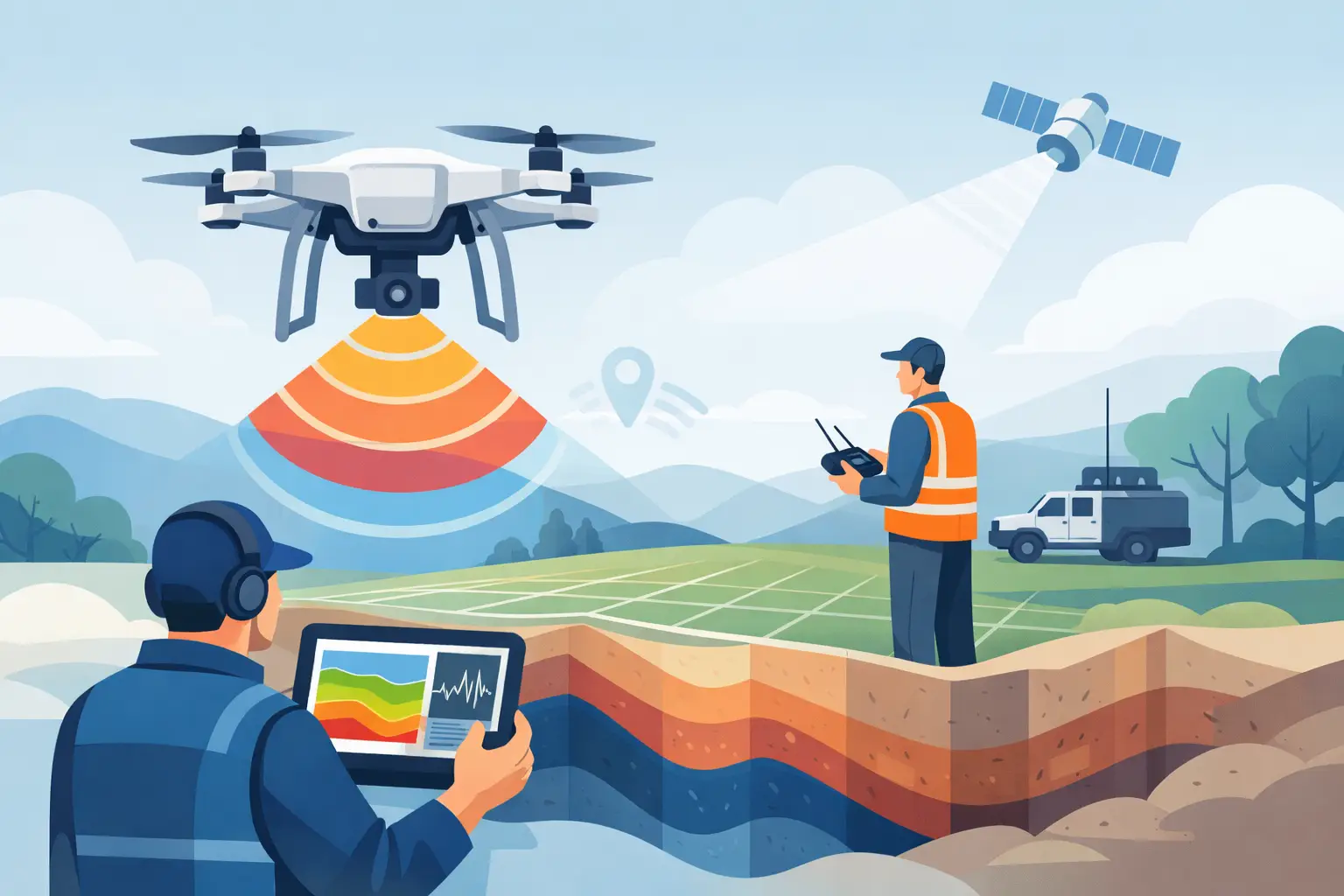
A missed structure at the reconnaissance stage can carry into drilling, design, permitting, and capital allocation. That is why drone geophysical survey services are no longer a niche option for remote sensing programs. For mining, groundwater, utilities, and corridor development, they have become a practical way to acquire calibrated, decision-grade data faster than most ground campaigns and with far less mobilization burden than conventional manned aircraft.
What matters is not the drone itself. What matters is whether the survey system, calibration regime, flight design, and interpretation workflow produce data that can withstand technical review and support investment decisions. Enterprise buyers are not purchasing flight hours. They are commissioning a geoscience deliverable that must be traceable, cross-validated, and usable inside engineering and planning workflows.
What drone geophysical survey services actually cover
The term is often used too broadly. In practice, drone geophysical survey services refer to airborne acquisition of geophysical measurements using unmanned platforms, followed by processing, QA/QC, inversion or interpretation, and delivery in a format aligned to the client’s objective. Depending on the program, that objective may be mineral targeting, structural mapping, groundwater delineation, utility detection, environmental baseline work, or route and site screening.
The most relevant sensor classes include aeromagnetic systems, electromagnetic payloads, radiometric instruments, LiDAR, and optical payloads used to support terrain correction, structural interpretation, and site modeling. The commercial value comes from integration. Magnetic data without topographic control, or electromagnetic data without geology and surface context, often leaves too much ambiguity. Multi-sensor design reduces that ambiguity and shortens the path from acquisition to action.
In technical procurement terms, the service should include survey planning, control and calibration, field execution, data conditioning, positional validation, interpretation, and sector-specific reporting. Buyers should expect products rather than raw files alone. That means gridded datasets, processed maps, anomaly classification, target ranking, and documentation of survey parameters and QA/QC outcomes.
Why buyers are shifting from conventional methods
The shift is being driven by operational math. Ground geophysics remains valuable, especially where line spacing must be extremely tight or where terrain and vegetation permit efficient access. Manned aircraft still have advantages on very large regional blocks where payload and endurance dominate. But there is a wide operational band where drones are the better instrument.
That band includes projects requiring rapid mobilization, high spatial control, lower altitude acquisition, selective area coverage, and safer operation around difficult access zones. In desert terrain, escarpments, wadis, concession edges, and linear infrastructure corridors, drones can often collect higher-resolution data with less field exposure and lower logistics overhead.
For executive stakeholders, the commercial case is straightforward. Faster acquisition means faster screening of prospects, faster engineering inputs, and fewer delays in advancing programs to the next gate. For technical teams, the case is more specific. Lower flying height can improve anomaly definition. Repeatable flight paths improve consistency. Digital mission planning improves auditability. Together, those factors support more defensible interpretation.
Where drone geophysical survey services create the most value
Mining and mineral exploration is an obvious application, but it is not the only one. Aeromagnetic and electromagnetic surveys are highly effective in early-stage target generation, regolith mapping, lineament analysis, and structural interpretation. They are also useful in refining drill targeting where ground follow-up needs to be focused rather than broad.
Water resource programs are another strong fit. Drone-borne electromagnetic methods can assist in identifying subsurface contrasts relevant to aquifer characterization, salinity mapping, and groundwater exploration. In arid environments, where every field day and every borehole has a cost consequence, screening larger areas from the air can materially improve siting decisions.
Infrastructure and utilities also benefit. Corridor planning, buried utility detection support, environmental constraint mapping, and terrain-informed engineering can all be strengthened by integrated drone surveys. Where projects must balance subsurface risk, surface access, and accelerated timelines, the ability to collect multiple datasets in one mobilization becomes commercially significant.
Government and strategic development programs have a further requirement: consistency across wide portfolios. A service provider that can standardize acquisition, QA/QC, and reporting across multiple sites gives agencies and large asset owners a cleaner basis for comparison and prioritization.
The technical factors that separate useful data from expensive noise
Not all drone geophysical survey services are equal, even when the sensor label appears identical. Data quality depends on platform stability, sensor mounting geometry, navigation precision, altitude control, survey speed, line spacing, environmental noise management, and calibration discipline. If those variables are poorly managed, the result may look impressive on a map but fail under technical scrutiny.
Magnetic surveys, for example, are highly sensitive to heading effects, platform interference, altitude variation, and diurnal conditions. Electromagnetic data introduces its own complexity, including system drift, coupling behavior, inversion assumptions, and depth-of-investigation limits. Radiometric surveys are strongly influenced by altitude, speed, and terrain effects. Every method has strengths, and every method has failure modes.
This is why serious operators treat the mission as a controlled measurement process rather than a flight exercise. Survey lines are designed against the geology and target scale. Tie lines are incorporated for levelling. Calibration routines are documented. Base station or reference procedures are defined. Deliverables are checked against internal acceptance criteria before interpretation begins.
For buyers, one practical rule applies. Ask how the contractor validates the data, not just how they acquire it. A capable provider should be able to explain positional control, sensor calibration, noise filtering, cross-line checks, repeatability, and how interpretation is constrained by ground truth or existing geology.
Interpreted outputs matter more than raw acquisition
Raw geophysical data has limited value to most project owners unless they maintain internal teams with the time and specialist software needed to process and interpret it. That is why the strongest service model is Data-as-a-Service rather than aircraft-for-hire.
The output should answer a project question. Where are the priority structural trends? Which anomalies meet the target criteria? What zones indicate conductive contrasts relevant to groundwater or utilities? How does the subsurface intelligence integrate with topography, surface geology, and existing asset data? If the reporting package does not help resolve those questions, acquisition alone has not delivered much value.
A disciplined reporting workflow also improves procurement confidence. Audit-traceable metadata, processing notes, map scales, interpretation logic, and limitations statements make the deliverable usable across technical review, management approval, and downstream engineering. This is especially important on projects involving external consultants, regulators, joint ventures, or public-sector oversight.
Trade-offs buyers should evaluate before commissioning a survey
The right method depends on scale, objective, and site constraints. Drone platforms are highly effective, but they are not universal replacements for manned aircraft or ground methods. If a project covers a very large regional extent, endurance and payload economics may favor conventional airborne systems. If the required target resolution is extremely fine and access is easy, ground surveys may still be the best choice.
Weather, airspace restrictions, and terrain complexity also matter. So does the required depth of investigation. Some targets are better suited to magnetics, others to electromagnetic methods, and many require integrated interpretation rather than reliance on a single dataset. A credible contractor will state those limitations clearly instead of forcing every problem into the same sensor package.
Procurement teams should also distinguish between pilot surveys and full deployment. A pilot can be the right commercial decision where geology is uncertain, reporting requirements are still being defined, or method suitability needs to be proven before scaling. It reduces commitment while generating site-specific performance evidence.
What to look for in a service partner
The strongest providers combine geophysics, aviation discipline, and sector fluency. Those three capabilities need to sit together. A flight team without geoscience depth may deliver data that is technically incomplete. A geology team without operational control may struggle with consistency and field execution. Industrial clients need both.
Look for evidence of documented QA/QC, sensor integration experience, desert-ready operations where relevant, and reporting that aligns with mining, water, energy, or infrastructure decision cycles. The provider should be able to explain how they manage calibration, mission planning, safety, permissions, data custody, and interpretation accountability.
This is where a specialist operator such as Air Solutions becomes relevant to enterprise buyers in the Gulf. The differentiator is not generic drone capability. It is the ability to mobilize quickly, operate in harsh conditions, fuse multiple sensing modalities, and issue fully auditable technical outputs that support real project decisions.
Drone geophysical survey services are most valuable when they reduce uncertainty early enough to change what happens next. If a survey can sharpen drill targeting, improve groundwater siting, de-risk a corridor, or shorten the path to engineering decisions, it has done more than collect data. It has improved the quality and speed of execution, which is the metric that matters when projects are moving on capital, schedule, and public accountability.